

TL;DR:
- Dried bouquets are a sustainable alternative for decor, but the right technique and environment are crucial for long durability. Air-drying is the simplest method and requires patience, while silica gel preserves colors and shape better. Correct placement, care, and variation in materials yield professional and timeless results.
Dried bouquets have become a natural choice for those who want beautiful decoration without having to replace flowers every week. But without the right dried bouquet checklist, it's easy to make mistakes that shorten their lifespan or ruin their colors. Questions like which flowers are best suited, which drying method to choose, and how to care for the bouquet afterward are common, whether you are a private individual or an interior decorator. This article covers everything step-by-step, from selection and drying techniques to care and creative use in the home.
Table of Contents
- Key Points
- 1. Checklist for Choosing the Right Flowers and Plants
- 2. Air-Drying: The Classic Method
- 3. Silica Gel: For Preserving Color and Shape
- 4. Oven Drying: Fastest but Riskiest
- 5. Comparison of Drying Techniques
- 6. Common Drying Mistakes to Avoid
- 7. Care Tips for Dried Bouquets in Interior Decor
- 8. How to Decorate with Dried Flowers in the Home
- 9. DIY Dried Bouquets: Assemble a Complete Bouquet from Scratch
- 10. Seasonal Planning: When to Pick and Dry?
- 11. The Dried Flower Guide: Bringing Together Everything You've Learned
- My Experience with Dried Bouquets in Practice
- Explore Torrdecor's Dried Bouquets
- FAQ
Key Points
| Point | Details |
|---|---|
| Choose the right flower type | Flowers with low moisture content and robust petals yield the best drying results. |
| Air-drying is easiest | Hang bouquets upside down in a dark, dry, and ventilated space for 2 to 4 weeks. |
| Silica gel preserves color best | This method takes 1 to 2 weeks and produces sharper colors than air-drying. |
| Placement determines durability | Avoid direct sunlight and high humidity to extend the bouquet's lifespan. |
| Care is simple but important | Regular dusting and hairspray protect against fragmentation and discoloration. |
1. Checklist for Choosing the Right Flowers and Plants
Having a clear dried bouquet checklist starts with flower selection. Not all flowers dry equally well. The result depends on the flowers' moisture content, petal structure, and stem strength.
Flowers and plants suitable for drying:
- Roses: Choose half-open buds. Fully open roses lose their petals more easily during drying.
- Lavender: One of the most rewarding to dry. Retains its scent for a long time and works excellently in mixed bouquets.
- Hydrangea: Dries well but requires the flower to be partly withered before hanging. Otherwise, it shrinks too quickly.
- Pampas grass: Naturally dry material that doesn't even need an active drying process. Adds volume and texture to bouquets.
- Statice and strawflower: Almost unchanged after drying. Perfect as filler flowers in DIY dried bouquets.
- Eucalyptus: Retains its shape and grey-green color well. Gives bouquets a modern and natural look.
Mixing flowers, grasses, and ethereal plants like lavender and pampas grass yields a durable and aesthetically pleasing result. So, it's about considering the bouquet as a whole, not just individual flowers.
What to avoid:
Flowers with thick, water-rich petals like tulips and amaryllis rarely dry well. They tend to turn brown, mold, or completely lose their shape. The same applies to tropical flowers with high water content.
Season and color choice:
Choose flowers in their natural peak season. Summer and early autumn provide the best raw material. Seasonal elements for dried bouquets like autumn-colored leaves, seed pods, and thistles work excellently as complementary materials.
Stick to natural, earthy tones for a timeless result. Strong bright red or vibrant pink flowers tend to fade more noticeably during drying.
Pro tip: Buy flowers at the market early in the morning when they have just arrived. They are freshest then and have the best cell structure for drying. Avoid flowers that have been in water for a long time at the florist.
2. Air-Drying: The Classic Method
Air-drying is the method most people start with, and for good reason. It requires no equipment and gives a natural, slightly rustic result.
Step by step:
- Remove leaves and unnecessary twigs from the stems. Leaves mold more easily than flower heads and retain moisture.
- Divide the flowers into smaller bundles of 5 to 10 stems. Too large bundles dry unevenly in the middle.
- Tie them together with rubber bands, not string. Rubber bands contract as the stems shrink, keeping the bundle together.
- Hang them upside down in a dark, dry, and well-ventilated space.
- Check every other day after the first seven days.
Air-drying takes approximately 2 to 4 weeks and requires a dark, dry, and ventilated spot for best results. It's a methodical process, not a quick project.
What can go wrong:
The most common problem is mold. This occurs when humidity is too high or air circulation is too poor. Continuous checking during the drying process significantly reduces the risk. A poorly ventilated basement is therefore a worse option than a well-ventilated storage room or a dry hallway.
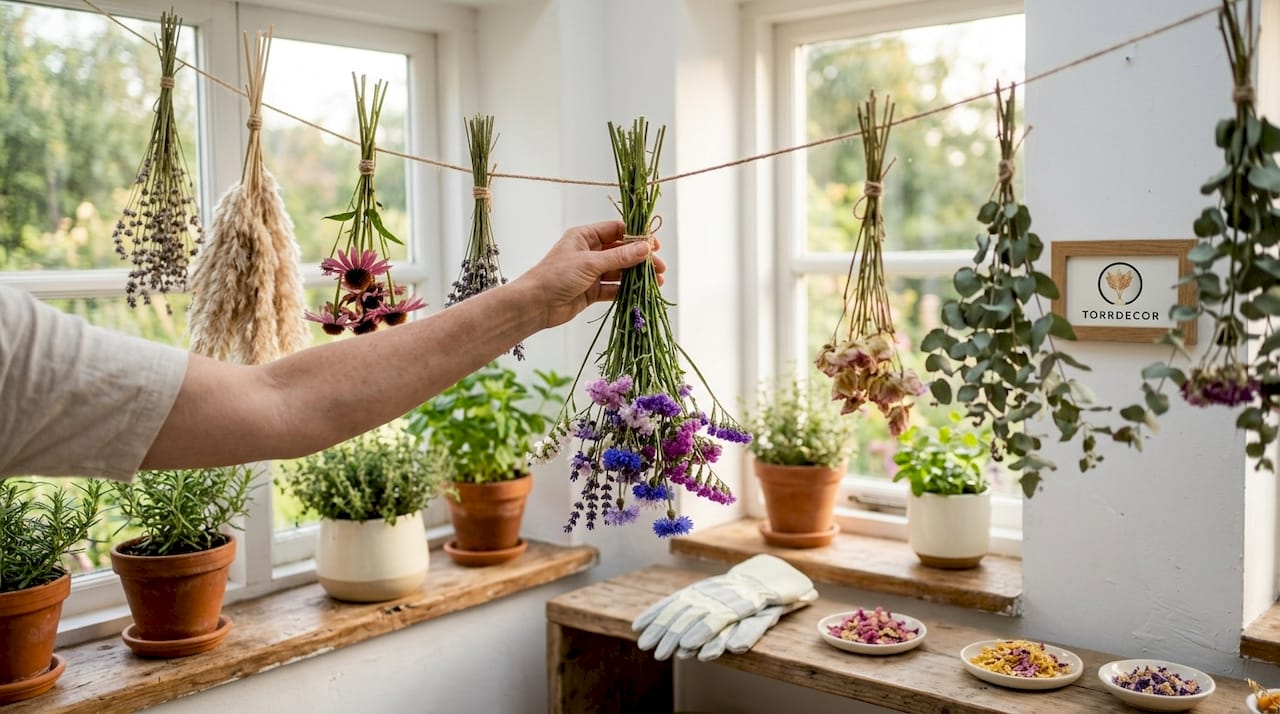
Pro tip: Are you hanging flowers near a window? It looks nice, but sunlight quickly fades colors. Choose an inner side of a cupboard or a dark pantry instead.
3. Silica Gel: For Preserving Color and Shape
Silica gel is an absorbent material in the form of small crystals that draw moisture from flowers. This method provides a finer and more "fresh" appearance compared to air-drying.
Step by step:
- Pour a layer of silica gel, about 2 to 3 centimeters, into the bottom of an airtight container.
- Place the flowers with petals facing up, without them touching each other.
- Carefully pour more silica gel around and over the flowers until they are completely covered.
- Seal the container and label it with the date.
- Open and check after one week.
Silica gel preserves flower color and shape better and is faster than air-drying, taking approximately 1 to 2 weeks. It is an excellent choice for more delicate flowers like roses and peonies.
Pros and cons:
This method costs a bit more for the silica gel itself, but the crystals can be dried in the oven and reused many times. The disadvantage is that you dry one flower at a time, or in limited quantities depending on the container size. It is therefore more labor-intensive per bouquet.
4. Oven Drying: Fastest but Riskiest
Oven drying is suitable for those short on time who want quick results. However, this method requires precision and careful monitoring.
Step by step:
- Preheat the oven to 30 to 45 degrees Celsius. Lower temperature is better.
- Arrange the flowers in a single layer on baking paper.
- Leave the oven door ajar to allow moisture to escape.
- Check every 30 minutes.
- Remove the flowers when they feel dry but not brittle.
Oven drying is the fastest but risks affecting flower shape and requires careful monitoring at a low temperature. If the flowers overheat, they shrink, lose their shape, and can even burn.
This method is best suited for leaves and more robust plant material. Delicate petals rarely survive the oven process without damage. Consider this technique as a complement to the other methods, not as a first choice for beautiful bouquets.
5. Comparison of Drying Techniques
It's easy to get confused about which method is best. Here's a comprehensive comparison to make the choice easier.
| Method | Time | Effort | Cost | Color Preservation | Best for |
|---|---|---|---|---|---|
| Air-drying | 2 to 4 weeks | Low | None | Medium | Lavender, pampas grass, statice |
| Silica gel | 1 to 2 weeks | Medium | Medium | High | Roses, peonies, delicate flowers |
| Oven drying | A few hours | High | Low | Low | Leaves, robust plants |
The choice of drying method depends on the desired result and timeframe. If you want the best drying techniques for a professional result, combine air-drying for bulk materials like pampas grass with silica gel for more delicate flower heads.
A bouquet with the right mix of methods and materials can look like a professionally arranged decoration, without costing a fortune. This is one of the most underestimated advantages of making DIY dried bouquets at home.
6. Common Drying Mistakes to Avoid
Common drying mistakes are often easy to avoid once you know what to look out for. Here are the most frequent problems and how to address them.
Flowers picked too late: If you wait until the flowers are fully open, it's too late. The petals will detach during the drying process. Pick flowers in a semi-open stage for best results.
Incorrect environment: A damp basement or bathroom won't do. Choosing the right drying location is crucial. Dark, dry, and well-ventilated are the basic requirements.
Bundles too large: Bundles with too many stems dry unevenly. The center of the bundle does not receive enough air circulation, increasing the risk of mold.
No checking during the process: Many people set up the bouquet and forget about it for three weeks. This is a mistake. Regular checks, every other day for the first ten days, are the difference between a successful and an unsuccessful outcome.
Incorrect handling after drying: Dried flowers are fragile. Grabbing the petals or carrying bouquets without supporting the stems are common reasons for flowers breaking immediately. Handle them gently and always with support underneath.
7. Care Tips for Dried Bouquets in Interior Decor
Caring for dried bouquets is more about what to avoid than what you actively need to do. With proper placement and minimal handling, a bouquet can last a long time.
A dried bouquet can last between 6 months and several years with proper care and placement. This is one of the strongest arguments for choosing dried flowers over fresh ones.
Importance of placement:
Do not place the bouquet in direct sunlight. UV radiation quickly fades colors and makes the material brittle. Instead, choose a bright, shady spot or under an overhead light without a direct beam on the bouquet.
High humidity, such as near a sink or in a bathroom, significantly shortens the bouquet's lifespan. Choose dry rooms like the living room, bedroom, or office.
Cleaning and maintenance:
Dust accumulates on dried flowers. Use a soft brush, a hairdryer on a cool setting, or a straw to gently blow away the dust. Avoid wiping with a damp cloth.
Spray with hairspray after drying for increased durability and to reduce fragmentation. It's a simple and inexpensive trick that makes a big difference, especially for more delicate materials like lavender and statice.
You can read more about this in Torrdecor's guide on caring for dried flowers for more practical advice.
8. How to Decorate with Dried Flowers in the Home
Decorating with dried flowers provides a calm and natural aesthetic that suits most interior styles. Here are concrete tips on how to do it best.
Choose the right vase:
A dried bouquet doesn't need water, which opens up entirely new choices. Tall, narrow vases highlight pampas grass and eucalyptus. Furthermore, lower vessels are better suited for compact bouquets with roses and hydrangeas.
Combine materials:
Feel free to mix dried flowers with other natural materials. Sticks, pinecones, feathers, and dried citrus fruits create depth and texture. A bouquet consisting only of flowers can easily feel flat compared to one that includes various types of plant material.
Inspiration ideas for the home:
- Hang a bunch of lavender in the kitchen for both decoration and scent.
- Place a large vase with pampas grass and dried grasses in a corner of the living room for an organic, natural look.
- Create a wall decoration with dried flowers tied with raffia and string. This works just as well as paintings and lasts longer.
- Use dried flowers as table decor for dinners. They don't require watering and stand stable all evening.
- Place a bunch of dried eucalyptus in a bowl in the hallway as a welcoming decor.
Torrdecor's inspiration guide for dried flowers contains further ideas and style inspiration for different types of homes.
9. DIY Dried Bouquets: Assemble a Complete Bouquet from Scratch
Making DIY dried bouquets from scratch is easier than most people think. The key is planning and a wide selection of materials.
What you need:
- Dried flowers and plants of at least 3 different types for variation
- Rubber bands and floral tape
- Scissors and floral knife
- Natural binding tape like raffia or hemp
- Possibly silica gel for delicate flowers
Building the bouquet:
Start with the coarsest material like pampas grass and eucalyptus as the base. Then add the mid-level with flowers like roses or hydrangeas. Finish with the finest, smallest details like lavender, statice, or dried berries.
Keep all stems gathered in one hand and adjust height and direction continuously. Tie together with rubber bands and then cover with raffia for a natural and neat finish.
How long does a homemade bouquet last:
It depends on the drying time and the quality of the material. A well-made homemade bouquet with properly dried material can last one to three years with correct placement and proper care at home.
10. Seasonal Planning: When to Pick and Dry?
Seasonal elements for dried bouquets give you a clear advantage if you plan drying in advance. Not all flowers and plants are available year-round, and quality varies greatly depending on the season.
Spring:
Early spring offers tulips and daffodils, but these rarely dry well. Better choices in spring are mimosa and forget-me-nots. Pick early in the morning when the temperature is low and humidity is stable.
Summer:
Summer is peak season. Lavender is best picked in July before the flower has fully opened. Roses and peonies are suitable for silica gel drying. Statice, strawflowers, and poppies are picked and air-dried directly.
Autumn:
Autumn offers ferns, seed pods, autumn leaves, and thistles. These materials dry quickly and give bouquets a warm, earthy tone that is perfect for autumnal decor. Eucalyptus keeps best if picked during autumn and early winter.
Winter:
Winter materials are limited but valuable. Juniper, twigs, and dried pinecones complement bouquets in a natural way. Pampas grass is available all year round and serves as a base in all seasons.
11. The Dried Flowers Guide: Bringing Together Everything You've Learned
The guide to dried flowers is best summarized as a three-step process: choose right, dry right, and place right. Each step affects the final result and the bouquet's longevity.
Having a clear checklist for dried bouquets means you don't have to guess. You know which flowers are suitable, you know which method gives the best result for that particular material, and you know how to care for and place the bouquet afterward to keep it looking good for a long time.
What distinguishes a bouquet that lasts one year from one that lasts three years is not luck. It is method, environment, and a few simple care habits. Torrdecor also offers a complete guide to successful drying if you wish to delve deeper.
My Experience with Dried Bouquets in Practice
I've seen people underestimate the simple air-drying method and go straight for silica gel because it sounds more advanced. But in reality, air-drying is often the best choice for beginners. It requires no purchases, is forgiving if you make a small mistake, and yields a natural result that suits most interior settings.
What I've learned from working with dried materials is that patience and the right environment make more of a difference than the technique you choose. A flower hung in a dark, well-ventilated pantry gives a better result than a flower in a trendy kitchen with open shelves, no matter how beautiful the environment is.
I also see a pattern among those who fail. They pick the flowers too late, bundle too many stems together, and then forget the bouquets without checking them. The result is mold or collapsing flowers. This is easy to avoid. Just three minutes of checking every other day during the first ten days is enough.
What I find truly underrated is the combination of materials. A bouquet containing only one type of flower looks simple. A bouquet with three to five different types of materials, at least one of which is a grass or an ethereal plant, looks professional. It's not about quantity. It's about variety and contrast in form and texture.
— Torrdecor
Explore Torrdecor's Dried Bouquets
Have you acquired a taste for working with dried bouquets but want a professionally finished option as a base or complement? Torrdecor offers a carefully curated assortment of dried bouquets for interior decoration that are ready to be placed directly in your home, shop, or at an event.

The bouquets are carefully selected to last a long time and suit modern interior environments. The assortment includes everything from simple natural arrangements to more complex bouquets with pampas grass, dried flowers, and grasses. Torrdecor targets those who want high quality without having to spend time on the drying process themselves. You can find the products directly on bouquets at Torrdecor, and the team will gladly help you with personalized advice if you are an interior designer or need several bouquets for a project.
FAQ
Which flowers are best suited for drying?
Flowers with low moisture content and robust petals work best. Lavender, roses in bud, statice, hydrangeas, and eucalyptus are common good choices for dried bouquets.
How long does air-drying take?
Air-drying typically takes 2 to 4 weeks depending on the flower type and environment. A dark, dry, and well-ventilated space yields the best results.
How long does a dried bouquet last?
A dried bouquet lasts from 6 months to several years if placed correctly, i.e., away from direct sunlight and high humidity.
What is the difference between air-drying and silica gel?
Air-drying is simple and free but takes longer and results in more faded colors. Silica gel takes less time and preserves color better, but requires purchasing materials and more work per flower.
Can I use hairspray on dried flowers?
Yes. Spraying with hairspray after drying reduces fragmentation and extends shelf life. It is a simple and inexpensive way to protect more delicate materials such as lavender and statice.
0 comments