

In short:
- White clay can be kaolin in crosswords, a ceramic clay in kiln work, or a gentle skincare ingredient. The context determines the meaning, and all forms have different properties and uses.
White clay is a collective term for white or white-beige clay types used in three completely different areas: crosswords, ceramics, and skincare. The most common form is kaolin, a natural mineral clay with a white color and plastic consistency. Depending on the context, “white clay” can refer to kaolin in a crossword, a firing stoneware clay from Bohusläns Keramiklera AB, or a gentle cosmetic ingredient in a face mask. Understanding which area is being referred to is crucial for correctly interpreting the meaning.
What does white clay mean in crosswords and geology?
In crossword puzzles, the answer to the clue “white clay” is almost always kaolin. Krysslexikon describes kaolin as a white, plastic clay, making it the standard answer in Swedish crosswords. It's good to know this if you encounter the clue.
Geologically, kaolin is formed when feldspar weathers over a long period. The result is a fine-grained, white mineral with low plasticity compared to ordinary clay soil. Kaolin occurs naturally in large parts of the world and is industrially mined in Brazil, China, and Cornwall in England, among other places.
Kaolin differs from ordinary soil due to its pure white color, fine grain size, and chemical stability. These properties make the mineral useful in so many different industries.
Kaolin's most important geological properties:
- Color: Pure white to white-beige
- Grain size: Very fine, less than 2 micrometers
- Chemical composition: Aluminum silicate with the formula Al₂Si₂O₅(OH)₄
- Plasticity: Lower than ordinary clay, but moldable when moist
- Thermal stability: Withstands high temperatures without melting
Kaolin is not only used in crosswords and geology. The same mineral appears in paper, plastics, rubber, and cosmetics. It is thus a raw material with wide industrial application.
White clay in ceramics: firing or air-drying?
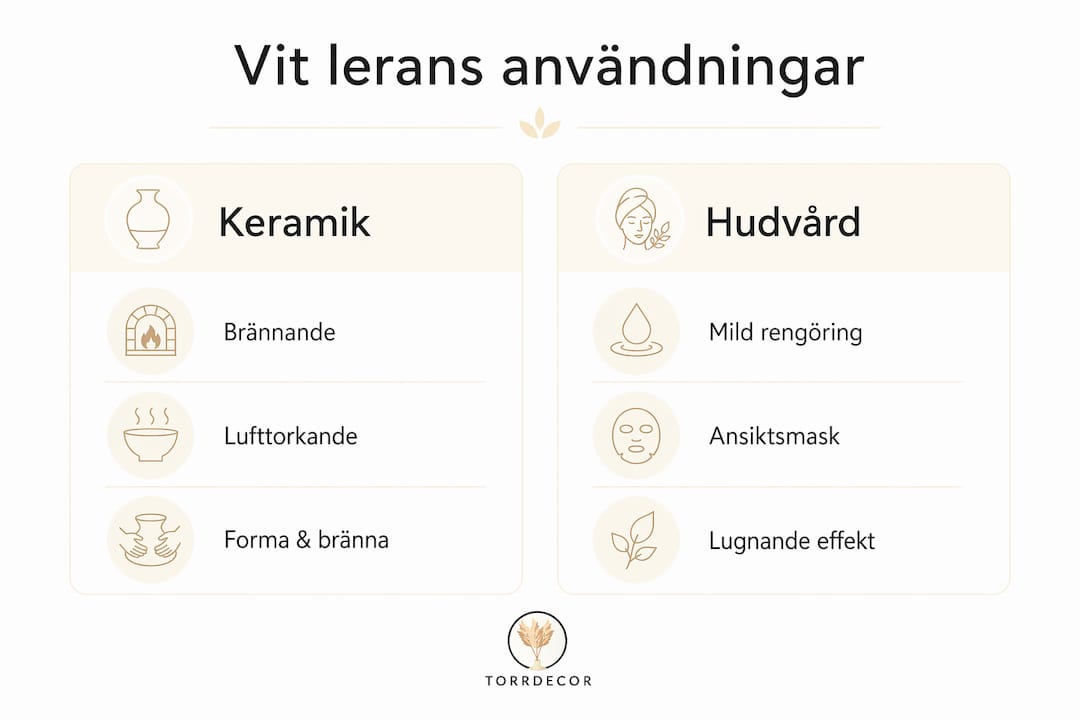
Ceramicists encounter the concept of white clay in two completely different forms, and it is important not to confuse them. The choice of clay type directly affects the final result.
| Property | White Stoneware Clay (firing) | Air-drying white clay |
|---|---|---|
| Firing temperature | approx. 1,300°C | No firing required |
| Drying shrinkage | 6% | Varies |
| Firing shrinkage | 8% | Not applicable |
| Final result | Hard, dense ceramics | Lighter, more fragile |
| Suitable for | Pots, plates, sculptures | Crafts, jewelry, decor |
White stoneware clay from Bohusläns Keramiklera AB is fired at approximately 1,300°C and shrinks 6% during drying and an additional 8% during firing. This means that an object that is 10 cm in size before drying ends up at approximately 8.6 cm after firing. Ceramicists must account for this shrinkage already in the design phase.
Air-drying white clay hardens without a kiln. Bohusläns Keramiklera AB recommends allowing the clay to dry completely before any post-drying in a household oven at a maximum of 100°C. The drying time varies from a few hours to a day depending on the thickness of the object.
The most common mistake is to confuse air-drying clay with firing clay. Air-drying clay cannot withstand oven temperatures above 100°C and will crack if exposed to the heat of a ceramic kiln. The result is ruined work and disappointment.
Pro tip: Always allow air-drying clay to dry at room temperature until it is completely dry before placing it in the oven. Feel the object. If it feels cold to the touch, it still contains moisture and is not ready.
How is white clay used in skincare?
Kaolin clay in skincare is gentle, soothing, and cleanses without drying out the skin. This property makes kaolin a popular ingredient in face masks and cleansing products for sensitive skin.
Naturli describes kaolin as a clay with pH 5.5, which is close to the skin's natural pH value. This means that the product does not upset the skin's acid-base balance. Kaolin also reduces visible pores and provides a soothing sensation upon application.
Kaolin clay's most important properties in skincare:
- Gentle cleansing without stripping the skin's natural oils
- pH 5.5 adapted to the skin's natural environment
- Soothing effect on irritated or red skin
- Reduces visible pores after regular use
- Suitable for sensitive, dry, and normal skin
It is important to distinguish between cosmetic use and medical treatments. The benefits of kaolin clay are cosmetic, not medically documented. Kaolin therefore does not treat skin conditions such as eczema or rosacea. It is a cleansing and caring agent, not a medicine.
Products with kaolin are best suited as part of a daily skincare routine. A face mask with kaolin is typically used one to two times per week. Daily cleansing with a kaolin-containing cleanser, such as products from Naturli, provides a milder and more continuous effect.
White clay in crafts and hobbies
White clay is a popular material in creative projects such as jewelry making, sculpting, and decorative objects. The material is easy to work with, inexpensive, and available in most hobby stores.
The process from raw clay to finished object follows a clear order:
- Shape the object while the clay is moist and pliable. Work quickly to prevent the clay from drying unevenly.
- Allow to dry at room temperature for at least a couple of days. Drying time varies depending on the size and thickness of the object.
- Check that the clay is completely dry before the next step. A cold feeling against the skin means that moisture remains.
- Post-dry in the oven at a maximum of 100°C if you are using air-drying clay, to reduce the risk of cracks.
- Paint with acrylic paint or other paint after the clay is completely cured. Painting on damp clay results in an uneven finish and poor durability.
Cracks usually occur for two reasons: too rapid drying or uneven thickness in the object. Thinner sections dry faster and contract more, creating tension in the material. Solve this by keeping the thickness even and loosely covering the object with plastic film during the first hours of drying.
Pro tip: Mix a little water into the clay if it starts to dry during work. A damp sponge next to the work surface keeps the clay pliable longer and reduces the risk of early cracks.
Key insights
White clay is kaolin in crosswords, a specific ceramic clay in kiln work, and a gentle cosmetic ingredient in skincare. The context always determines the meaning.
| Point | Details |
|---|---|
| Kaolin in crosswords | The standard answer to the clue "white clay" is kaolin, a white plastic clay. |
| Ceramic shrinkage | White stoneware clay shrinks a total of about 14% from raw form to finished fired ceramic. |
| Air-drying clay | Always dry completely at room temperature before post-drying in an oven at max 100°C. |
| Kaolin in skincare | pH 5.5 makes kaolin gentle for sensitive skin, but the effects are cosmetic, not medicinal. |
| Crafts and hobbies | Painting is always done after full drying, otherwise the paint will not last. |
Context is everything when it comes to white clay
I've noticed that the most common confusion surrounding white clay arises when people mix up the different contexts. A person searching "what is white clay" could mean three completely different things depending on whether they're doing a crossword, a ceramics project, or looking for a face mask.
What surprises me is how often hobby ceramists buy air-drying clay believing it works like firing stoneware clay. The result is ruined work and unnecessary frustration. The difference is clear on the packaging, but it requires knowing what you're looking for.
For skincare, the same applies. Kaolin is a good cleanser for sensitive skin, but it's not a panacea. I often see exaggerated claims about kaolin clay's health benefits. Stick to what research actually says: mild cleansing and soothing effect, nothing more.
If you're working with white clay pots and decorative objects, my best advice is to always read the product description carefully and choose clay based on its intended use, not its color.
— Torrdecor
Decorative white clay products from Torrdecor
White clay is not only used in ceramics and skincare. It is also a popular material for decorative vases and interior details that fit modern homes.

Torrdecor offers a range of white clay vases and decorative accessories manufactured in Portugal, with a focus on sustainability and stylish design. The vases pair perfectly with dried plants such as pampas grass 110 cm, which require minimal care and last a long time. The combination of white clay and natural dried plants creates a calm and timeless expression in the home. Torrdecor delivers to individuals, interior designers, and businesses throughout Sweden.
Frequently Asked Questions
What is kaolin and why is it called white clay?
Kaolin is a natural aluminum silicate mineral with a white color and plastic consistency. It is called white clay because it is formed from weathered feldspar and has a pure white to off-white color.
Can you eat white clay?
Eating clay, including kaolin, occurs in some cultures but is not recommended. Kaolin is used in some medical contexts as an anti-diarrheal, but it is not a food and should not be consumed without medical advice.
What is the difference between firing and air-drying white clay?
Firing white stoneware clay requires kiln temperatures of approximately 1,300°C and produces hard, dense ceramics. Air-drying white clay hardens at room temperature and cannot withstand high kiln temperatures.
How long does it take for air-drying white clay to dry?
Drying time varies from a few hours to a couple of days depending on the size and thickness of the object. The object is ready when it no longer feels cold to the touch.
Is white clay good for all skin types?
Kaolin is best suited for sensitive, dry, and normal skin due to its pH of 5.5 and gentle cleansing effect. Oily skin may require stronger clay types like bentonite for deeper cleansing.
0 comments