

TL;DR:
- Dried flowers last longer and are more sustainable than fresh cut flowers.
- Air drying, silica gel, and pressing are common methods for preserving flowers.
- Choosing the right type of flower and good ventilation are crucial for a successful result.
Fresh cut flowers are beautiful, but they often wilt within a week. It's frustrating when you've spent time and money on a lovely arrangement only for it to end up in the bin. Dried flowers solve this problem simply. With the right technique, you can preserve your favorite flowers for months or even years, creating personal decorations that last. This guide will take you through the entire process, from choosing the right varieties to avoiding common mistakes. You'll learn air drying step-by-step, as well as alternative methods like silica gel and pressing. The goal is for you to feel confident and ready to get started immediately.
Table of Contents
- Choose the right flowers and materials for drying
- Step-by-step: Air dry flowers in the best way
- Alternative methods: Silica gel, pressing, and microwave
- Avoid common mistakes and create long-lasting arrangements
- Our view on dried flowers: What we wish more people knew
- Discover sustainable dried bouquets and pampas grass
- Frequently Asked Questions about drying flowers
Key Insights
| Point | Details |
|---|---|
| Choose the right varieties | Not all flowers are suitable for drying – preferably choose small, sturdy flowers without much moisture in the stem. |
| Air and small bunches | Always dry flowers in a well-ventilated area and in small bunches to avoid mold. |
| Different methods available | In addition to classic air drying, silica gel and microwave also work for certain projects. |
| Avoid common mistakes | Moisture and too dense arrangements are the biggest causes of unsuccessful drying. |
| Hair spray for fixation | A few thin layers of hair spray can help preserve the shape but does not replace the drying process itself. |
Choose the right flowers and materials for drying
Now that you know why dried flowers are appealing, the next step is to select the flowers and materials you'll start with. The choice of flower is actually crucial for whether the result will be successful or not.
Flowers suitable for drying
Small-flowered and relatively dry varieties work best. Here are some reliable choices:
- Roses are excellent, especially at the bud stage. They hold their shape well and the color transforms into a soft, matte tone.
- Lavender is one of the easiest options. It dries quickly, still smells lovely, and lasts a long time.
- Everlasting flowers (Helichrysum) are made for drying. They retain almost exactly the same appearance as fresh.
- Grasses and pampas grass are rewarding and require minimal care during drying.
- Lisianthus and thistle provide interesting textures and dry without problems.
Our guide to dried flowers contains more tips on which varieties suit different interior styles.
Varieties you should avoid
Flowers with thick, water-filled leaves and flower heads rarely yield good results. Lilies, hyacinths, and tulips do not hold their shape and risk molding. Large compound flower heads can work, but they require extra space and a long drying time. As a rule of thumb, the thinner and drier the flower is from the start, the better it handles drying.
Tools and materials you'll need
You don't need much to get started:
- Sharp floral scissors or knife
- Thin string or rubber band
- Gloves if working with thorny varieties
- A dry, well-ventilated place, preferably a dark room or an attic
- Hair spray (for fixation, not drying)
Flowers with heavy heads must be hung upside down, and dense bunches should be avoided to prevent mold. This is one of the most common mistakes, and something we will return to later.
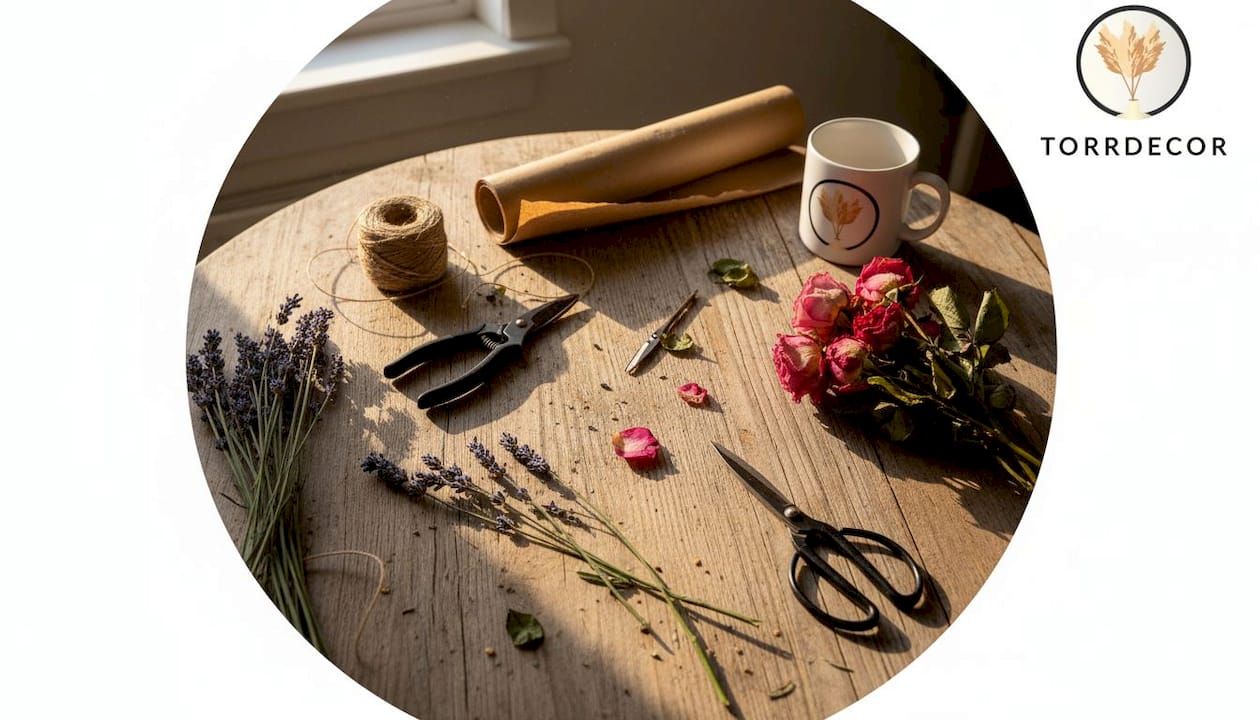
Table: flower types and drying method
| Flower type | Best method | Sensitivity level |
|---|---|---|
| Roses | Air drying | Medium |
| Lavender | Air drying | Low |
| Everlasting flowers | Air drying | Low |
| Lisianthus | Air drying / Silica gel | Medium |
| Daisy | Pressing | High |
| Orchid | Silica gel | High |
| Pampas grass | Air drying | Low |
Pro tip: Always dry in small bunches of 8 to 12 stems per bunch. Larger bunches trap moisture in the middle, significantly increasing the risk of mold.
Step-by-step: Air dry flowers in the best way
Once you have selected your flowers and prepared the materials, it's time to begin the drying process. Air drying is the classic and most commonly used method, and it's a great place to start.
Preparation
Start by cutting the flower stems at an angle, roughly 45 degrees. This provides a cleaner surface. Then, remove all leaves below where you plan to tie the bunch. Leaves left in the bunch retain moisture and can lead to mold.
Step by step
- Gather 8 to 12 flower stems and tie them loosely with string or a rubber band. Not too tight, air must be able to circulate.
- Hang the bunch upside down on a hook, rope, or beam. Hanging upside down is important for the flower heads to maintain their shape.
- Choose the right location, a room with good air circulation, low humidity, and minimal daylight. Direct sunlight quickly fades the flowers' color.
- Wait 2 to 4 weeks depending on the flower type and humidity. Thinner flowers like lavender can be ready in 10 to 14 days.
- Check the result by feeling the stems and petals. Everything should feel dry, slightly rustling, and stiff.
- Spray with hairspray as a final step to fix the shape and protect against dust.
Remember that hairspray does not dry flowers. It is solely a fixative you use after the flowers are completely dry.
Good ventilation and avoiding moisture are crucial to prevent mold. This applies especially during the first few days when the flowers still contain a lot of water.
Common mistakes to avoid
- Humid rooms like bathrooms or kitchens are not suitable for drying.
- Too large bunches block airflow in the middle.
- Direct sunlight destroys colors and makes flowers brittle.
- Forgetting to check the bunches during the first few days. If you see signs of mold early, you can still save the flowers.
Read more about how to care for your finished flowers in our article on care of dried flowers.
Pro tip: If you are unsure, start by drying individual flowers instead of entire bouquets. This way, you'll quickly learn how the varieties you've chosen behave without risking the entire batch.
Alternative methods: Silica gel, pressing, and microwave
Air drying is the most common method, but sometimes other techniques may be more suitable depending on the type of flowers or the purpose of the project. Here we review three alternatives and when they are best used.
Silica gel
Silica gel is a granular material that absorbs moisture very effectively. You fill an airtight container with silica gel, place the flowers in it, and cover them completely. After 3 to 7 days, the flowers are dry and have preserved both their shape and color better than with air drying.
This method works excellently for flowers with complex shapes, such as roses and orchids, which are harder to air dry without losing their structure. The disadvantage is that silica gel costs more and requires an initial purchase. However, you can dry and reuse the granules in the oven.
Pressing
Pressing is suitable for flat arrangements, such as bookmarks, cards, or frames. You place the flowers between absorbent paper in a flower press or heavy book and leave them for 2 to 4 weeks.
Steps for pressing:
- Choose flowers with a relatively flat structure; daisies, violets, or verbena work well.
- Place the flowers on a sheet of absorbent paper without overlapping.
- Cover with a new sheet of paper and close the press or stack heavy books on top.
- Change the paper after 3 to 5 days to absorb excess moisture.
- Check after 2 weeks if the flower is completely flat and dry.
Microwave
The microwave is the fastest option. You can dry single flowers in just a couple of minutes. Place the flower between microwave-safe papers, set the microwave to low power, and run for 30 to 60 seconds at a time. Check between each run.
The result is rarely as natural as air drying, but the method works well for quick projects or when you want to test a new flower type quickly.
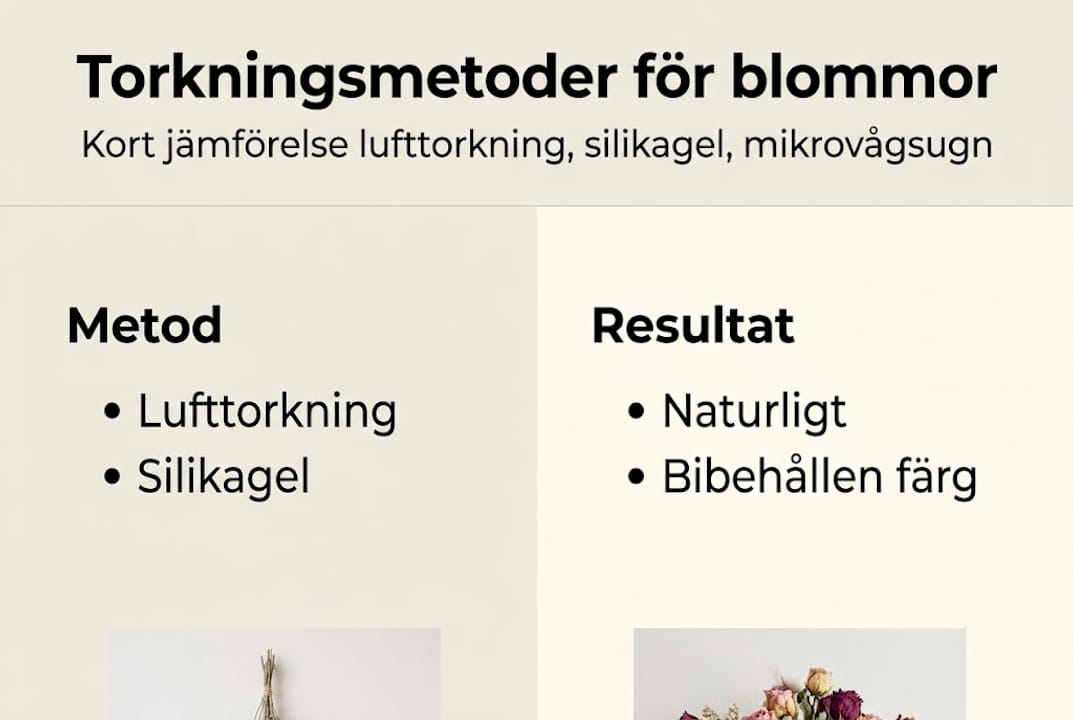
Silica gel provides a professional result but requires special materials; air drying is most natural and requires the least equipment.
Comparison table: drying methods
| Method | Time | Result | Cost | Best for |
|---|---|---|---|---|
| Air drying | 2 to 4 weeks | Natural | Low | Most flower types |
| Silica gel | 3 to 7 days | Very good | Medium | Roses, orchids |
| Pressing | 2 to 4 weeks | Flat and neat | Low | Cards, frames, art |
| Microwave | Minutes | Varies | Low | Quick tests |
Find more practical advice in our article on sustainable bouquets where we go through how to build beautiful arrangements from scratch.
Avoid common mistakes and create long-lasting arrangements
To enjoy your dried arrangement for a long time, it's important to avoid some pitfalls and plan the end result. Many who try for the first time make similar mistakes, and most are easy to prevent.
The most common mistakes
- Too dense bunches. This is the single most common problem. The denser the bunch, the poorer the air circulation and the higher the risk of mold in the middle.
- Wrong flower choice. Trying to dry thick-leafed varieties like hyacinths or peonies almost always leads to disappointment.
- Drying in a humid environment. Kitchens and bathrooms are popular places, but they are the worst possible for drying.
- Lack of patience. Taking down the flowers too early means they are not completely dry and will continue to absorb moisture afterwards.
- Direct sunlight. Color fades quickly in strong light. Choose a shady but well-ventilated spot.
To reduce the risk of mold, avoid dense bunches and dry in good ventilation. This is advice we cannot emphasize enough.
Sustainable arrangements in practice
Once your flowers are dry, it's important to handle them gently. Dried stems are brittle. Avoid moving the arrangement too often, and never bend the stems forcefully.
Keep them away from:
- Moisture and condensation, for example, near windows in winter
- Direct sunlight which fades colors
- Pets and children who can break the delicate stems
For inspiration on how to combine dried flowers with modern interior trends, take a look at our interior-inspired trends. And if you want to understand why dried flowers are a smart choice from a sustainability perspective, read more about sustainable decoration choices.
Statistics to keep in mind: The most common causes of unsuccessful drying are mold due to poor ventilation and incorrect flower choice. These two factors account for the majority of all failed home drying projects.
Pro tip: For longer durability, store dried flowers in a protected area away from moisture and direct sunlight. A glass dome or an open shelf with good air circulation in a dry room works excellently.
Our view on dried flowers: What we wish more people knew
After many years of experience in dried plants and interior design, there are some insights that are rarely mentioned in standard guides, and they actually make a big difference.
What we see most often is that people underestimate the importance of patience. Ventilation and time are not just advice; they are the prerequisites for a successful result. Anyone who rushes the process and takes down the flowers a little too early, or packs the bunch a little too tightly, almost always ends up with mold problems. It's normal to want to see results quickly, but dried flowers reward those who wait.
Another thing we notice is that hairspray is often misunderstood. Many believe that spraying helps with drying. This is not true. Hairspray is a fixative you use after the flowers are completely dry, not during the process.
We also want to highlight something that might feel a bit controversial: not all flowers should be dried at home. Some varieties, and some interior design projects, are better suited to professionally dried alternatives. There's no shame in buying ready-made dried bouquets when the project requires a specific look or an exact color tone. Understanding the limits of home drying is itself a sign of good judgment.
Feel free to compare the pros and cons of different decoration choices in our article on dried vs. fresh flowers to find the right solution for your home.
Discover sustainable dried bouquets and pampas grass
If you want to get started right away or find inspiration for new projects, you can discover a lot with us at Torrdecor. We offer a wide range of ready-made dried arrangements, practical accessories, and vases to suit all types of interior styles.

Here you will find carefully selected dried bouquets that are ready to display immediately, without you having to wait weeks for them to dry. We also offer dried pampas grass in several varieties, perfect for both minimalist and more nature-inspired homes. All products are chosen with a focus on sustainability and long-lasting beauty. Also explore our blog posts and guides for more ideas and advice on dried plants and interior design.
Frequently asked questions about drying flowers
Which flowers are best to dry at home?
Flowers like roses, lavender, and immortelles are well-suited for drying and yield the best results with air-drying due to their relatively dry structure.
How do I prevent mold when drying flowers?
The risk of mold is reduced with good ventilation and small bunches of 8 to 12 stems, so that air can circulate freely around each stem.
Can I use a microwave oven to dry flowers?
Yes, microwaving is a method for quick-drying single flowers, but the result is rarely as natural and durable as with air-drying.
Why should one use hairspray on dried flowers?
Hairspray fixes but does not dry flowers. It is only used as a final step to preserve the shape and protect against dust when the flower is already completely dry.
0 comments