

In short:
- Slow living means living consciously and choosing the right pace for each activity to reduce stress. It focuses on presence, quality, and sustainability in everyday life, not on doing everything slowly. Creating small routines and a calm home environment can contribute to a healthier and more meaningful life.
Slow living is a conscious way of life where you choose the right pace for each activity instead of always pushing yourself. The concept is sometimes called tempo giusto in Italian, roughly “the right pace,” and was coined by Canadian author Carl Honoré as a reaction to our era's demands for constant productivity. It's not about literally doing everything slowly, but about choosing the right pace for each situation. Research shows that a conscious lifestyle lowers chronic stress and blood pressure, and that the quality of your social relationships is the single strongest factor for health and longevity.
What is slow living and why does it matter?
Slow living is defined as the conscious management of attention and focus to break autopilot thinking and increase presence. It is not a trend but a reaction against a society that measures value by how much you can accomplish. The core is to prioritize quality, presence, and meaningfulness over quantity and stress.
The philosophy is based on three core principles. The first is intentionality: you actively choose what you spend your time and energy on. The second is presence: you are mentally and physically available in what you are doing. The third is sustainability: you choose a pace you can maintain for a long time without burning out.
Slow living is closely related to mindfulness and presence, but it is not the same thing. Mindfulness is a technique for training attention, often in meditation. Slow living is a broader lifestyle choice that affects how you work, eat, decorate your home, and socialize with others. The Slow Food philosophy, which emerged in Italy in the 1980s as a protest against fast-food culture, is an early example of the same mindset applied to eating habits.
What health benefits does a slower life offer?
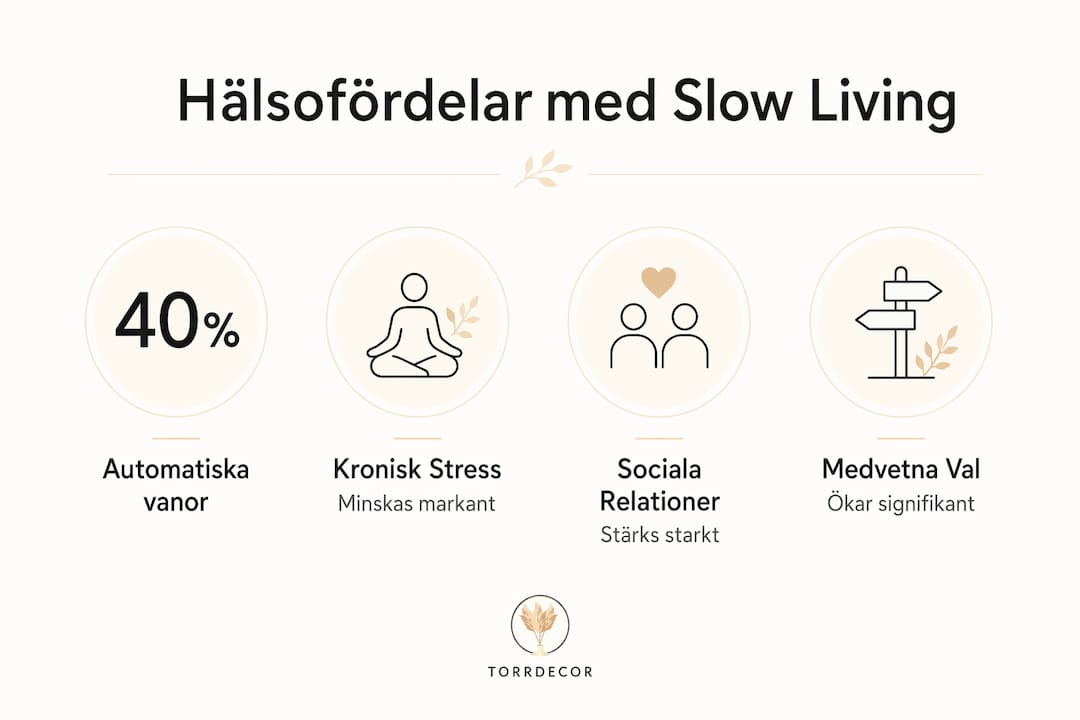
Slow living provides concrete health benefits by lowering chronic stress and blood pressure when you prioritize quality of experience over constant productivity. It is not a feeling but a measurable outcome.
“The quality of our social relationships is the strongest factor for health and longevity. Not wealth, not fame, not hard work. Relationships.” Harvard's longest study on human well-being, ongoing since 1938.
That study followed 268 men and their families and found that the quality of social relationships is more strongly linked to health and longevity than almost any other factor. This is a direct argument for slow living's focus on presence in relationships over superficial contact.
Another important insight: approximately 40% of daily actions are automatic habits, not conscious choices. This means that a calmer life requires a change in habits, not solely willpower. You cannot think your way to a balanced life. You must rebuild the routines that govern you on autopilot.
Slow living also reduces what is called chronic background stress, the low-grade tension that arises when you always have too much going on. This type of stress is difficult to notice but continuously burdens the nervous system. Creating free zones in everyday life, even short ones, gives the nervous system time to recover.
Is slow living only for those who live in the countryside?
The most common misconception about slow living is that it requires life-changing transformations, such as moving out of the city or quitting your job. That is not true. Small islands of stillness are enough to make a real difference in everyday life.
Another common confusion is that slow living and minimalism are the same thing. Minimalism is about owning fewer things. Slow living is about how you live with what you have. You can live slow in a packed apartment in Stockholm if you choose wisely.
Here are the most common misconceptions and what is actually true:
- “I have to move to the countryside.” False. Slow living works in an urban environment. It's about how you structure your day, not where you live.
- “It requires a lot of time.” False. A ten-minute morning ritual without a phone is enough as a starting point.
- “Slow living is the same as being lazy.” False. It's about focus, not doing less.
- “I have to do everything at once.” False. Slow living is a gradual change, not an immediate transformation.
- “It requires expensive aesthetic interior design.” False. Mindset and simple home habits weigh more heavily than costly changes.
Pro tip: Avoid the perfection trap. If you miss a day of your slow living ritual, that's normal. Lower your expectations during stressful periods and stick to a single simple habit. That's enough.
Slow living is a gradient, not a switch. You gradually move towards a calmer life, and it's perfectly fine to take a step back sometimes.
How do you start slow living in everyday life?
The best way to start a calmer life is to identify your own stress points and create a small free zone around them. Don't try to change everything at once. Choose one thing.
- Create a morning buffer. Spend the first 15 minutes of your day without your phone. Drink coffee, look out the window, or write three sentences in a notebook. A simple morning ritual calms the nervous system and sets the tone for the rest of the day.
- Implement a digital break. Choose a time in the evening, for example, 9:00 PM, when you put away screens. This is sometimes called a “digital sunset” and helps the brain unwind before sleep.
- Practice “one-tasking.” Do one thing at a time. Eat without scrolling. Walk without listening to a podcast. Presence in simple activities is one of the most effective relaxation techniques available.
- Schedule time for reflection. Set aside ten minutes at the end of the week to ask yourself: What gave me energy? What drained my energy? This creates awareness of what truly nourishes you.
- Reduce consumption impulses. Wait 48 hours before buying something you haven't planned for. The Slow Food philosophy applies the same principle to food: choose fewer, better ingredients instead of constantly restocking.
Pro tip: Link your slow living ritual to something you already do every day, such as making coffee or brushing your teeth. This makes it easier to stick to the habit.
The environment you are in affects how easy it is to live slowly. A cluttered, noisy environment activates the nervous system. A calm, orderly environment makes it easier to be present. This applies to both the home and the workplace.
| Activity | Common version | Slow living version |
|---|---|---|
| Morning | Phone immediately upon waking | 15 minutes without screen |
| Lunch | Eating at the computer | Eating without a screen, preferably outdoors |
| Evening | Scrolling on the couch | Digital sunset at 9:00 PM |
| Weekend | Filling the schedule with activities | Leave at least one unplanned slot |
| Consumption | Impulsive buying | Wait 48 hours before purchase |
To reduce stress at home also means creating order in the physical spaces you live in. A tidy and well-thought-out home environment significantly reduces cognitive load.
How does the home environment support a calmer life?
The home plays a crucial role in your pace of life. An environment that amplifies stress makes slow living more difficult, no matter how much you want to change. Interior design affects stress levels in a direct and measurable way.
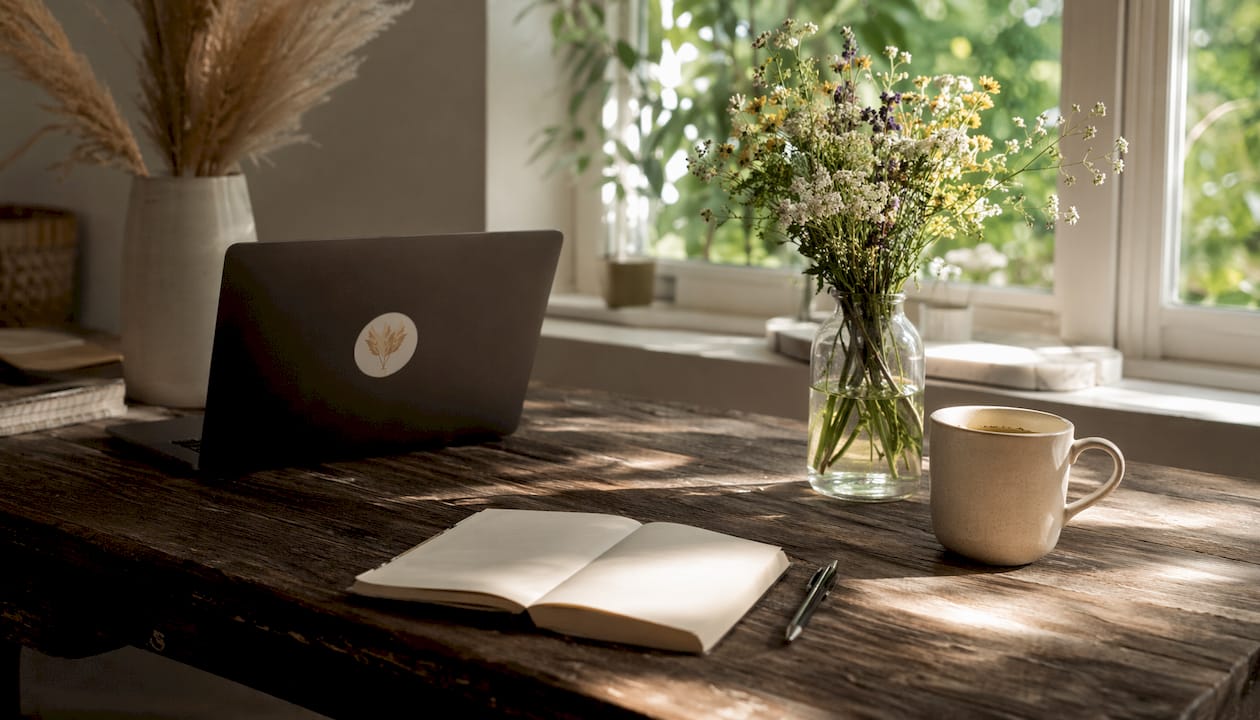
Natural materials such as wood, stone, linen, and dried plants create a visual calm that synthetic materials rarely provide. It's not about buying expensive items. It's about choosing materials that feel earthy and timeless. Sustainable interior design with a long lifespan also reduces the need to constantly replace and buy new items, which in itself is a slow living choice.
Here are concrete interior design choices that support a balanced life:
- Phone-free zone. Choose a room, or part of a room, where phones are not welcome. The bedroom is the obvious choice.
- Reading nook. A chair, a small table, and good lighting create a place for reflection without digital distractions.
- Natural decorations. Dried plants and pampas grass require no care and give a calm, organic impression that lasts a long time.
- Empty spaces. Leave surfaces empty. A clear surface on a table or shelf gives the eye rest and reduces visual stress.
| Design element | Effect on pace of life |
|---|---|
| Natural materials (wood, linen, dried plants) | Creates visual calm and reduces stress |
| Phone-free zone | Reduces digital distractions at home |
| Minimal ornamentation | Lowers cognitive load |
| Soft, warm lighting | Signals the body to unwind |
Natural materials in interior design are not just aesthetics. It is a choice that affects how you feel in your home every day.
Key insights
Slow living is a sustainable lifestyle choice that requires habit change, not willpower, and provides measurable health benefits when practiced consistently with small, daily rituals.
| Point | Details |
|---|---|
| Right pace, not slow | Slow living is about choosing the right pace for each activity, not doing everything slowly. |
| Habits govern 40% of the day | Since 40% of actions are automatic, habit change is required to live more consciously. |
| Social relationships are crucial | The quality of your relationships is the strongest factor for health and longevity. |
| Start small | A 15-minute morning ritual without a phone is enough as a starting point for a calmer life. |
| Home environment matters | Natural materials, phone-free zones, and order in the home directly reduce stress. |
My thoughts on slow living in practice
I've been following the slow living movement for a long time, and what surprises me most is how little it actually takes to notice a difference. Most people think they need to make big changes. That's not true.
The hardest part isn't starting. The hardest part is sticking with it when life accelerates. During stressful periods, it's easy to give up all rituals at once. That's a mistake. A single simple habit, like drinking morning coffee without your phone, is enough to keep you on track.
I am also skeptical of the aestheticized version of slow living seen on social media. Expensive linen tablecloths and perfectly arranged bookshelves are not slow living. That's another form of consumption. True slow living is quieter and more private. It's noticeable in how you talk to people, how you eat, and how you choose to spend a free hour.
What I recommend most is to start with the home environment. Not to buy new things, but to remove. Clear a surface. Create a place where you actually want to sit down and just be. It's a concrete step that costs nothing and has an immediate effect.
— a4
Torrdecor and a home that supports calm
A home that supports slow living doesn't have to be expensive or complicated. It needs to be thoughtfully designed.
Torrdecor offers dried plants and decorative vases that fit directly into a slow living environment. The products require minimal maintenance and last a long time, making them a sustainable choice for those who want a beautiful home without spending time on upkeep. Pampas grass 110 cm provides a natural and calm impression in any room, and vase "BÅGE" in cream, made in Portugal, is an example of a timeless interior design choice that doesn't age. Torrdecor is one of Sweden's leading suppliers of pampas grass and dried bouquets for homes, shops, and events.
Frequently asked questions
What does slow living actually mean?
Slow living is a conscious way of life where you choose the right pace for each activity instead of always pushing yourself. It is sometimes called tempo giusto and is about quality, presence, and meaningfulness over constant productivity.
Do you have to live in the countryside to live slow?
No. Slow living works in an urban environment. It's about how you structure your day and your habits, not where you live geographically.
How do you start slow living?
The easiest way is to create a 15-minute morning ritual without your phone. A single simple habit is enough as a starting point and can be gradually expanded.
Are slow living and minimalism the same thing?
No. Minimalism is about owning fewer things. Slow living is about how you live and what you prioritize, regardless of how much you own.
How does the home environment affect slow living?
The home directly reinforces or counteracts a calmer life. Natural materials, phone-free zones, and organized surfaces reduce cognitive load and make it easier to be present.
0 comments