

TL;DR:
- Drying flowers can be easy if you choose the right method for each flower and prepare them carefully.
- Air drying for up to three weeks provides natural and durable results, while silica gel preserves color and shape in a few days.
Cut flowers rarely last more than a week or two before wilting and ending up in the compost. This is a frustration many feel, especially when you have a beautiful bouquet you'd like to preserve. So, drying flowers correctly is not difficult, but it requires choosing the right method for the right flower and preparing properly. This guide covers everything from traditional air drying and press drying to faster alternatives with silica gel, so you can create lasting decorations that endure.
Table of Contents
- Key Points
- Preparation and Flower Selection
- Air Drying Step by Step
- Press Drying of Flowers and Petals
- Alternative Drying Methods
- Aftercare and Decoration Projects
- My Experience Drying Flowers
- Find Inspiration and Products at Torrdecor
- Frequently Asked Questions
Key Points
| Point | Details |
|---|---|
| Choose the right time | Pick flowers in the morning after the dew has dried and the flower has barely opened. |
| Air drying takes time | Hanging upside down for 2 to 3 weeks gives the best three-dimensional result. |
| Press drying suits petals | Individual petals are pressed flat and used in art, cards, and frames. |
| Silica gel preserves color | This method is faster and preserves the flowers' color better than air drying. |
| Storage is crucial | Dried flowers are damaged by moisture and direct sunlight; store them in a dry, shady place. |
Preparation and Flower Selection
Before you start drying flowers, it's worth spending some time on preparation. This is where most mistakes are made, and poorly prepared material yields poorer results no matter which method you choose.
The Right Time for Harvesting
The timing of when you pick your flowers plays a big role in the final result. According to expert recommendations, you should harvest in the morning after the dew has dried but before the sun becomes too strong. The flowers should ideally be in an early stage, meaning barely opened. A fully bloomed flower has already started to break down and dries less well.
Avoid picking flowers on damp or rainy days, as this significantly increases the risk of mold during the drying process. A dry and warm morning is the best option.
Flowers Suitable for Drying
Not all flowers dry equally well. Flowers suitable for drying usually have firmer petals and lower water content. Here are some of the best choices:
- Lavender dries excellently and retains its scent for a long time
- Roses work well, especially buds and semi-open flowers
- Peonies are popular but require a bit more care during drying
- Strawflowers (e.g., everlasting and helichrysum) dry quickly and retain their shape
- Hydrangea yields beautiful dried results with its compact flower head
- Delphinium and lavender are excellent for air drying in bunches
Flowers with high water content, such as tulips and daffodils, are more difficult to dry and often result in wrinkled or discolored outcomes.
Cleaning and Preparation
Remove loose leaves along the stem, especially the lower ones that would otherwise rot. Ensure the flowers are free from insects and dirt. Trim the stems cleanly and at an angle, just as you would when placing them in water.
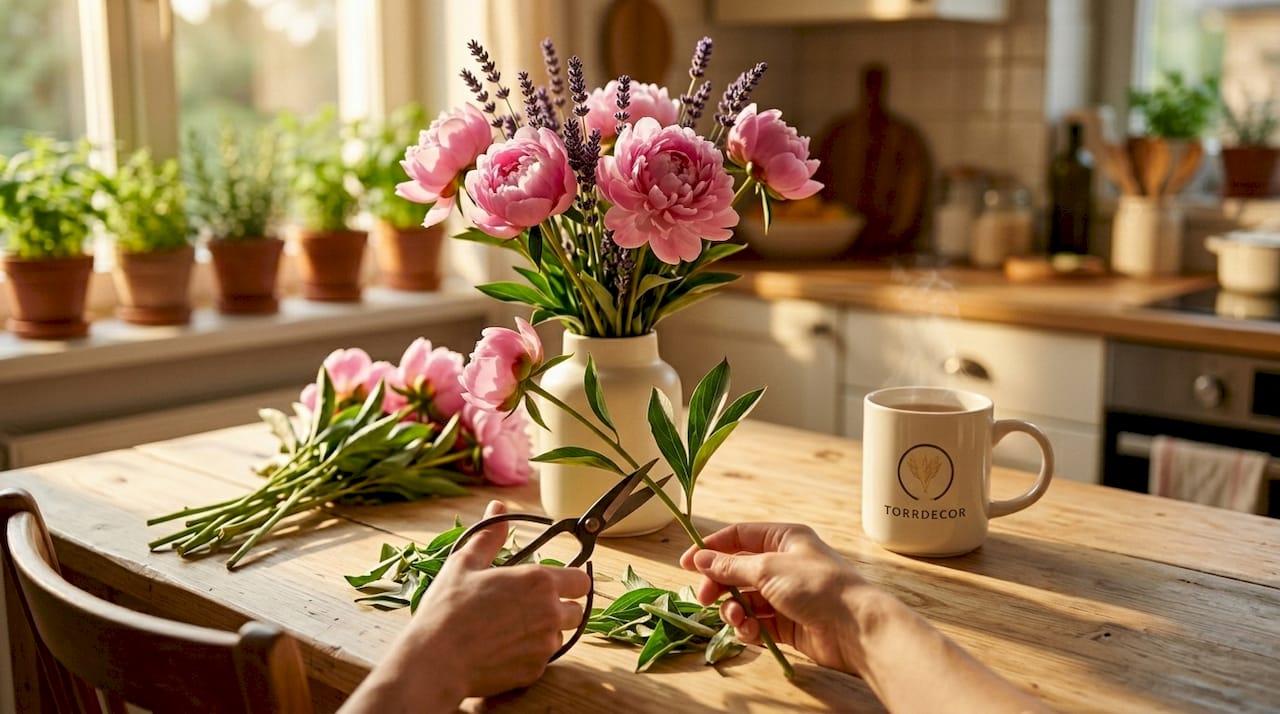
Pro tip: Never dry flowers that have already started to wilt. Always choose fresh specimens for the best final result.
The environment where you dry the flowers is as important as the condition of the flowers themselves. You need a place with good air circulation, low humidity, and preferably little to no direct light. A dark pantry, an airy hallway, or a well-ventilated garage works excellently.
Air Drying Step by Step
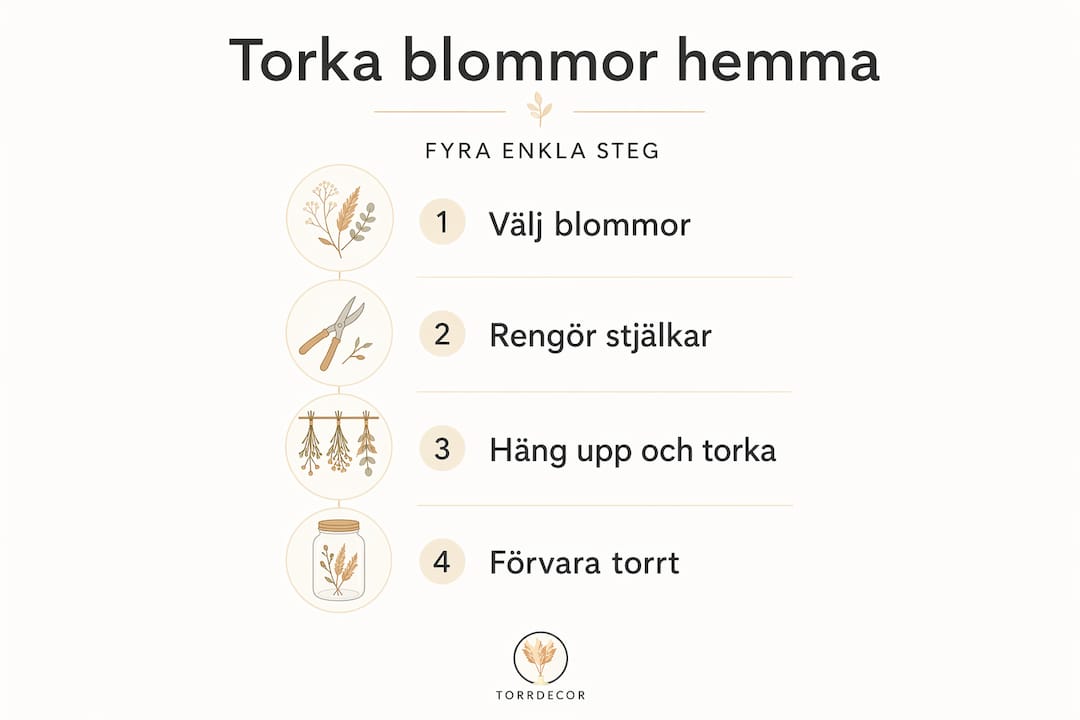
Air drying is the most common method and requires no special materials. The result is a flower that retains its three-dimensional shape and the stiffness of its stem, making it perfect for bouquets and decorations.
Follow these steps for best results:
- Gather the flowers into small bunches with 3 to 5 stems per bunch. More stems increase the risk of poor air circulation and mold.
- Tie the stems together with a rubber band or string near the base. Rubber bands are practical as they contract as the stems shrink during drying.
- Hang the bunches upside down on a hook, rope, or drying rack. Upside down is important; otherwise, the stems will bend and the petals may fall off.
- Choose the right location. The location should be dark, dry, and have good air circulation. Avoid bathrooms, basements with high humidity, and windowsills in direct sunlight.
- Wait 2 to 3 weeks. Check the bunches after a week and ensure there are no signs of mold. Feel the petals; they should start to feel papery and dry.
- Check if drying is complete by gently bending a stem. If it snaps or feels brittle, the flower is ready. If it's still soft and pliable, it needs more time.
“Air drying preserves the flowers' three-dimensional shape, making them suitable for decorative bouquets and wreaths. It is the method that gives the most natural appearance.” (Interflora)
Drying time varies depending on the flower type and environment. Lavender and strawflowers can be ready in 10 to 14 days, while peonies and roses often need a full 3 weeks. Patience is key.
A common cause of unsuccessful air drying is too large a bouquet. Three to five stems is the maximum. Air must be able to circulate freely around each flower; otherwise, moisture will build up inside the bunch and mold can form.
Press Drying of Flowers and Petals
Press drying differs fundamentally from air drying. The result is flat flowers and petals that are excellent for art, bookmarks, handmade cards, and frames. The method is simple but requires patience.
Here's how to do it:
- Select individual flowers or petals. Whole flowers with a flat shape, like pansies and violets, work best. Thick flowers like roses can be separated and pressed in parts.
- Place a layer of paper towels in a heavy book or flower press. Paper towels absorb moisture effectively.
- Arrange the flowers with a little space between them. They must not overlap, or they will stick together.
- Cover with additional paper towels and close the book. Place additional heavy books on top for extra pressure.
- Change the paper towels every 2 to 3 days to prevent moisture from accumulating and causing mold or discoloration.
- Wait a total of 2 to 3 weeks. Check regularly and change paper as needed until the flowers are completely dry and flat.
Pro tip: Place a thin layer of coffee filter closest to the flower instead of paper towels. Coffee filters do not stick to the petals as easily and provide a cleaner result.
A clear difference from air drying is that press drying yields flat flowers, while air drying retains volume. Choose the method based on what you plan to use the flowers for. For frames and cards, press drying is superior. For bouquets and wreaths, air drying is the right choice.
Pansies, daisies, lavender, and violets are among the best candidates for press drying. Avoid fleshy flowers with high water content; they take too long and risk molding before they have had time to dry properly.
Alternative Drying Methods
Sometimes you want a quicker result, or you want to preserve the flowers' color better. Then there are two alternative methods worth knowing about: silica gel and microwave.
Drying with Silica Gel
Silica gel is a granular material that absorbs moisture effectively and is used in many industries to keep products dry. For flower drying, it works excellently, especially when you want to preserve strong and clear colors.
Here's how to use silica gel:
- Pour a layer of silica gel into an airtight container, about 3 to 4 centimeters deep.
- Place the flowers stem down or lying flat, depending on the flower type.
- Gently pour more silica gel around and over the flowers until they are completely covered.
- Close the lid and leave for 2 to 7 days depending on the flower type and size.
- Carefully remove the flowers and brush off the granules with a soft brush.
Silica gel can be reused. Heat it in the oven at a low temperature (about 120 degrees Celsius) for an hour, and it will regain its absorbency.
Microwave: fast but requires caution
The microwave is the fastest method and can dry a flower in minutes. But it requires careful control, otherwise you will burn the flowers.
- Place the flowers between two layers of paper towels.
- Run on low power for 30 to 60 seconds at a time.
- Check after each round and feel if the flower starts to feel dry.
- Repeat until the flower is ready, usually 2 to 4 rounds.
Microwave works best for individual flowers and petals, not entire bouquets.
Comparison of Drying Methods
| Method | Drying Time | Color Preservation | Best for | Difficulty |
|---|---|---|---|---|
| Air drying | 2 to 3 weeks | Medium | Bouquets, wreaths | Easy |
| Press drying | 2 to 3 weeks | Good | Art, cards, frames | Easy |
| Silica gel | 2 to 7 days | Very good | Individual flowers | Medium |
| Microwave | 2 to 10 minutes | Varying | Individual flowers | Medium |
Silica gel is the best choice when you want to preserve a special flower with strong colors, such as a rose from a wedding or an anniversary bouquet. Air drying is the simplest and most practical option for larger volumes and everyday decoration.
Aftercare and Decoration Projects
Once dry, flowers are delicate. Handle them gently and give them proper storage, and they will last for months or even years.
Storage and Protection
Proper storage is what determines how long your dried flowers remain beautiful. Consider the following:
- Store flowers in a dry and cool place, preferably in a room with a stable temperature.
- Avoid direct sunlight; it fades colors quickly.
- Keep them away from high humidity, such as bathrooms and kitchens near the stove.
- If storing them in a box, place some tissue paper around them to reduce friction.
- Use a light spray of hairspray or fixative spray to stabilize petals and reduce dust accumulation.
Handling Without Damage
Dried flowers are brittle. Always hold them by the stem, never by the petals. Move them as little as possible and gently vacuum them on the lowest setting if they collect dust.
Creative Decoration Projects
Dried flowers are suitable for many different projects. Here are some ideas to get started:
- Dried bouquets in vases are the simplest option and provide a natural and durable element in the home.
- Wreaths and garlands made of dried lavender, roses, and strawflowers are suitable for doors and walls.
- Framed floral art with pressed flowers and petals is a personal and decorative piece of art.
- Lanterns and glass jars with dried flowers as decoration around a tea light create an atmospheric impression.
- Handmade cards and bookmarks with pressed flowers are appreciated gifts.
You can read more about how to use dried flowers in the home in Torrdecor's guide on sustainable floral decoration, where you will find more concrete ideas and tips for creating beautiful environments with minimal maintenance.
My Experience Drying Flowers
I've worked with dried flowers and natural decorations for a long time, and there's one mistake I see over and over again: people choose a method based on how quickly they want a result, not based on what they actually intend to use the flowers for.
It's understandable. You pick a beautiful bouquet and want to preserve it immediately. But if you rush the process with a microwave when you actually want a three-dimensional bouquet in a vase, you'll be disappointed. The petals shrink unevenly, and the stems lose their stiffness.
My experience is that air drying yields the best results for most purposes, and patience is the most important ingredient. Three weeks feels like a long time, but the result is a flower that looks natural and lasts for several years if stored correctly.
I've also learned that it pays to experiment with different flower types. Strawflowers and lavender are almost foolproof. Peonies and roses require more care but give fantastic results when successful. Start with the easy varieties and work your way up.
Another common mistake is hanging bouquets that are too large. I see it all the time. Five stems are the maximum, and three are often better. Air must be able to reach everywhere. A bouquet of ten stems looks like a good idea but often ends up with mold in the middle.
The creative aspect of drying flowers is that each method opens up different projects. Press drying naturally leads to art and cards. Air drying leads to bouquets and wreaths. Silica gel is suitable when you want to preserve something special. Feel what you want to create, then choose the method based on that.
— Torrdecor
Find Inspiration and Products at Torrdecor
Learning to dry flowers at home is a fantastic way to create sustainable decorations with a personal touch. But sometimes you want an immediate and professional result without waiting three weeks for drying time.

Torrdecor is one of Sweden's leading specialists in dried plants and natural decoration. The assortment includes dried bouquets, pampas grass in several varieties, and handmade vases from Portugal, all developed to create a beautiful and sustainable home with minimal maintenance. At Torrdecor, you will also find tips and guides on how to succeed with dried flowers and smart decorative choices. If you want to know more about what Torrdecor offers and how they work with sustainable floral decoration, you can read more on the About Torrdecor page.
Frequently Asked Questions
How long does it take to dry flowers?
Air drying and press drying usually take 2 to 3 weeks. Silica gel gives results in 2 to 7 days and microwave in a few minutes.
How do I dry flowers without them losing their color?
Silica gel is the method that best preserves the color. Air drying and press drying cause some fading, but storing them away from direct sunlight slows down the process.
Which flowers are suitable for drying?
Flowers suitable for drying include lavender, roses, peonies, hydrangeas, delphiniums, and strawflowers. Flowers with high water content, such as tulips, yield poorer results.
Why should flowers be hung upside down when air drying?
Hanging them upside down allows the stem to dry straight and prevents the petals from falling off during the process. It gives the dried flower a more natural and upright shape.
Can you dry flowers in the oven?
Yes, but it requires a very low temperature, around 40 degrees Celsius, and a long time, often 6 to 8 hours. The oven method is difficult to control and risks burning or discoloring the petals. Silica gel or air drying gives safer results.
0 comments