

TL;DR:
- Dried flowers are a sustainable and stylish alternative to fresh flowers.
- Proper preparation and method are crucial to avoid mold and damage.
- They can be used in interior design to create long-lasting and unique decorations.
Fresh flowers are beautiful, but they wilt within a week, leaving behind waste and empty vases. This is a pattern many are familiar with, which is precisely why interest in dried flowers has grown so significantly in recent years. Dried flowers are a sustainable, low-maintenance, and stylish alternative suitable for both private homes and professional interior design. This guide will show you exactly how to dry your own flowers step-by-step, which methods suit which varieties, and how to avoid common mistakes that can ruin the result. You'll also get practical tips on how to beautifully integrate them into your home.
Table of Contents
- What you need: materials and preparations
- Step-by-step: drying flowers with the most common methods
- Common mistakes and how to avoid them
- How to use and care for dried flowers in your decor
- Why dried flowers are the future of interior design – and what no one talks about
- Upgrade your home with dried flowers from Torrdecor
- Frequently asked questions about dried flowers
Key Insights
| Point | Details |
|---|---|
| Multiple methods available | You can air dry, use desiccants, or speed up with a microwave/oven – all yield different results. |
| Proper preparation wins | Best results require careful preparation and a method tailored to the flower type. |
| Avoid common mistakes | Too humid conditions and over-filled bouquets easily lead to mold and discoloration. |
| Sustainable decor | Dried flowers offer trendy and long-lasting decoration for both homes and public spaces. |
What you need: materials and preparations
Now that you know why dried flowers are a sustainable decor choice, let's start with what you need to get started.
First and foremost, it's about choosing the right flowers. Not all varieties are equally suitable for drying. Flowers with dense petals and low moisture content generally work best. Good choices for beginners include:
- Lavender – Retains both color and scent after drying.
- Roses – Work excellent but need to be picked just before full bloom.
- Baby's Breath – Easy to dry and gives an airy, decorative result.
- Immortelles and Strawflowers – Almost made for drying, perfectly retain their shape.
- Eucalyptus – Popular for its green leaves and pleasant scent.
- Pampas Grass – Impressive and trendy, dried flowers and smart choices shows how it can be combined with other varieties.
Avoid flowers with high moisture content, such as tulips and daffodils. They tend to rot or lose their shape during drying.
Tools and materials you'll need:
- Scissors or sharp pruning shears
- String, rubber bands, or floral tape
- Silica gel (for delicate varieties)
- Newspaper or absorbent paper (for pressing)
- A heavy book or flower press
- Dry, dark storage area with good air circulation
- Optional: drying cabinet for quicker and more even results
When choosing flowers to dry, ideally pick them when they are about to open but not fully bloomed. This yields the best final result as the crown retains its shape better. Pick the flowers early in the morning, when they have the most moisture left in the stem, but then let them stand in a glass of water for a couple of hours before you start drying. This stabilizes them.
Preparation plays a big role. Clean the stems of loose leaves and dirt. Leaves left on during drying can retain moisture and cause mold. Trim the stems to the desired length and bundle the flowers into appropriately sized groups, no more than 5 to 10 stems per bouquet. Larger bundles dry unevenly and risk mold formation in the center.
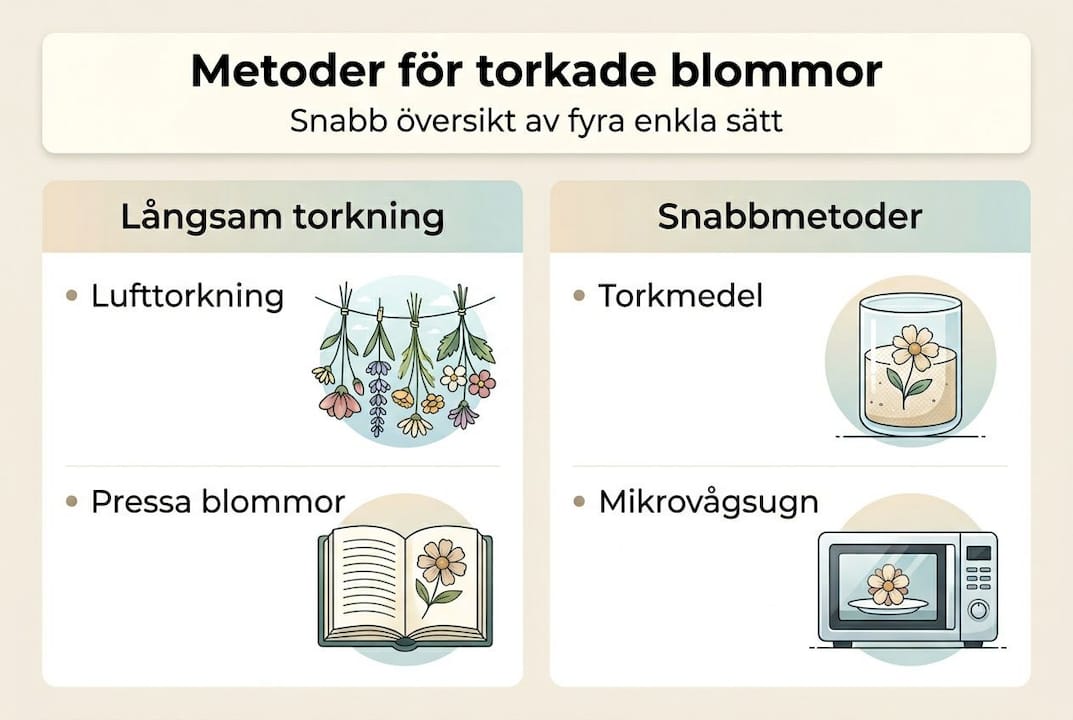
Primary methods for drying flowers include air drying, desiccation, pressing, and quick methods, and the choice of method depends on the flower type and the desired final result.
Pro tip: Don't tie the string too tightly around the bouquet. The stems shrink during drying, and a too tightly tied band can cause the flowers to fall apart when they are ready.
If you want a sustainable decorative interior that lasts, proper preparation is the most important step you can take.
Step-by-step: drying flowers with the most common methods
With proper preparations, you are ready to dry your flowers. Here is a guide for all common methods.
Method 1: Air Drying
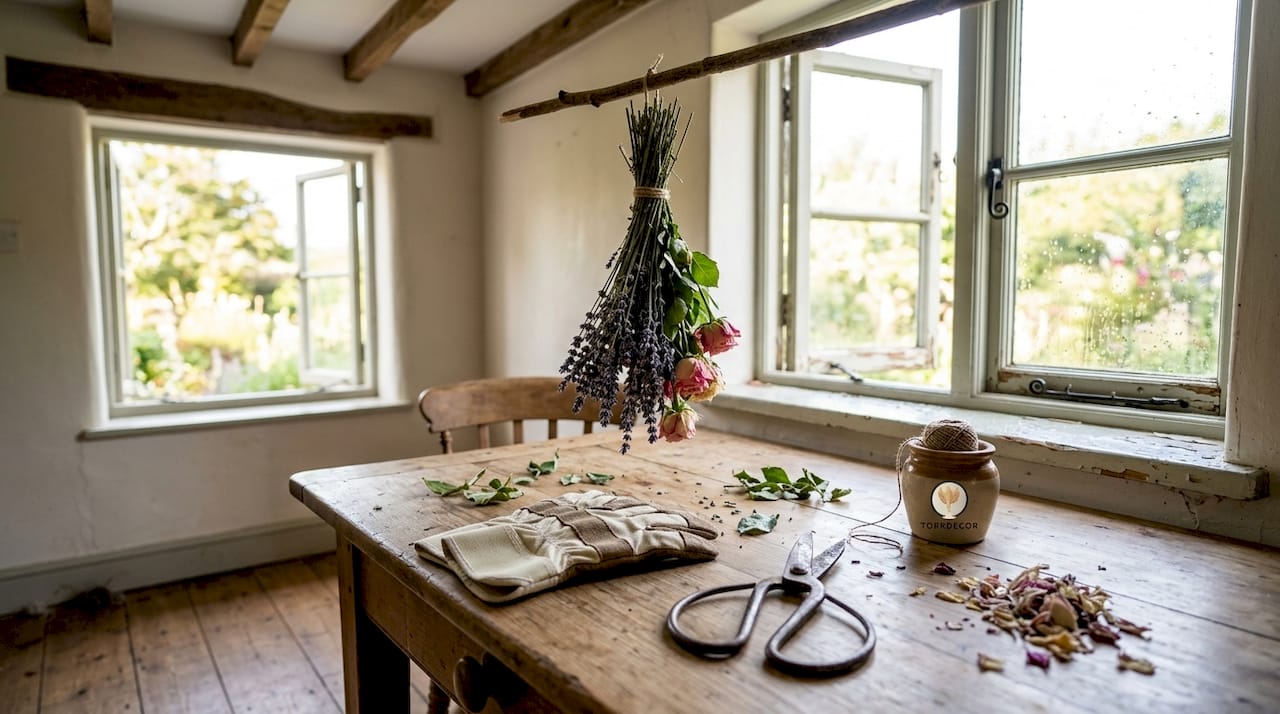
This is the most common and simplest method.
- Bundle the flowers into appropriately sized groups.
- Tie with string or rubber band.
- Hang the bouquet upside down on a hook in a dark, dry, and well-ventilated area.
- Let hang for 2 to 4 weeks until completely dry.
- Carefully take down and place in your desired vase or decoration.
Air drying preserves shape but risks mold in humid conditions, while silica gel protects delicate flowers but requires more effort.
Method 2: Silica Gel
Silica gel is a desiccant that absorbs moisture quickly and protects delicate flower varieties.
- Pour a layer of silica gel into the bottom of an airtight container.
- Place the flowers with the petals facing upwards in the container.
- Carefully cover with more silica gel until the flowers are completely covered.
- Seal the container and wait 3 to 7 days.
- Carefully remove the flowers and shake off excess gel.
Method 3: Pressing
Pressing is suitable for flat varieties such as wood anemones, violets, and ferns.
- Place the flower between two sheets of absorbent paper.
- Place the papers inside a heavy book.
- Place more books on top for added pressure.
- Leave for 2 to 3 weeks.
- Remove and use for frames, cards, or book art, for example.
Method 4: Microwave or Oven
These quick methods are suitable for more resilient varieties and yield results in hours rather than weeks.
For oven: Place the flowers on a rack in the oven at 40 to 50 degrees Celsius with the door slightly ajar. Check every 30 minutes.
Pro tip: Never use a microwave for delicate varieties like roses or baby's breath. There is a high risk that the flowers will quickly lose their shape and color.
| Method | Time | Difficulty | Best for |
|---|---|---|---|
| Air drying | 2 to 4 weeks | Low | Lavender, roses, pampas grass |
| Silica gel | 3 to 7 days | Medium | Roses, peonies |
| Pressing | 2 to 3 weeks | Low | Ferns, wood anemones |
| Oven/microwave | Hours | Medium | More resilient varieties |
For a step-by-step guide for sustainable bouquets, you can find further inspiration and detailed instructions.
Common mistakes and how to avoid them
Once you start drying flowers, you sometimes notice small mistakes. Learn how to avoid the most common problems here.
There are several classic pitfalls that even experienced enthusiasts fall into. Knowing about them beforehand saves you time, flowers, and frustration.
Common mistakes to avoid:
- Drying in a humid area. The bathroom or basement is often too humid. Always choose a dry area with good air circulation.
- Forgetting to clean the stems. Loose leaves and dirt retain moisture and greatly increase the risk of mold.
- Too large bouquets. A bouquet with too many stems dries unevenly. The middle of the bunch can remain damp for a long time and lead to mold.
- Direct sunlight during drying. The light quickly bleaches the flowers, resulting in grey, washed-out colors.
- Forcing drying with too much heat. Setting the oven too high causes the petals to shrink and crack.
- Taking down the flowers too early. If the middle of the stem still feels soft, the flowers are not ready.
If you notice the flowers smell musty or see white spots on the stems, it's a sign of mold. In that case, it's best to start over with new flowers.
A common misconception is that quick methods always yield results as good as air drying. This is not true for delicate varieties. Air drying can lead to mold if it's too humid, but professional drying cabinets best preserve the color.
Pro tip: If you live in a humid climate, place a small dehumidifier in the area where you dry the flowers. It makes a big difference to the final result.
Another mistake is mixing flower varieties in the same bouquet during drying. Different varieties have different drying times, and if one variety is ready while another is half-finished, the already dry flowers can start to get damaged. Dry the varieties separately and assemble the bouquet afterward.
When should you give up and start over? If the flowers have clear mold, have lost all petals, or smell strongly musty, it's time to discard them. It's normal to have a failed attempt at first. Learn from it and adjust the space and method.
More advice on long-term care can be found in our dried plants care guide and in our care tips for dried flowers to keep the results fresh longer.
How to use and care for dried flowers in your decor
After successful drying, the next step is to truly make the most of your own dried arrangements.
Dried flowers are flexible decorative elements that suit virtually all types of homes. There are many ways to use them, and you don't need to be an interior designer to succeed.
Popular ways to decorate with dried flowers:
- Vases and table arrangements. The classic choice. Choose a vase with the right proportions for the bouquet's size for a balanced look.
- Wall decorations. Hang a bouquet upside down against the wall for a bohemian touch. Pampas grass and eucalyptus work particularly well.
- Frames and artwork. Pressed flowers framed in simple glass or wooden frames create personal and unique works of art.
- Door wreath. A wreath of dried flowers welcomes guests and often lasts a whole season.
- Table setting and decor. Small bunches or individual flowers add life and texture to your dinner table.
Dried flowers are decorative and durable but require some care to avoid dust and color loss.
When it comes to placement, avoid window sills with direct sunlight. UV radiation breaks down the pigments in the petals and causes colors to fade quickly. Also, avoid areas with high humidity, such as kitchens near the stove or bathrooms.
Dust is one of the most common challenges with dried flowers. Use a soft brush or a hairdryer on a cool setting to gently blow away dust without damaging the petals. Do it gently and not too often; about once a month is enough.
Colors may fade over time. This is normal and part of the natural look that many actually appreciate. But if you want to slow down fading, place the flowers in a shady corner and avoid humid environments. You can also read more about trendy tips for interior design to combine dried flowers with modern decor styles.
Dare to mix varieties and colors. A bouquet of lavender, baby's breath, and eucalyptus adds depth and texture. Combine warm and cool tones for an interesting visual result. If you are unsure whether dried flowers are the right choice compared to fresh ones, a good comparison can be found in the article dried vs fresh flowers.
Why dried flowers are the future of interior design – and what no one talks about
Now that you know both how and why, it's time for a new perspective on dried flowers and their future role.
There's a lot of talk about dried flowers as an aesthetic trend, but what's rarely mentioned is how much they actually change behavior around consumption and waste. Fresh flowers are beautiful for weeks, but they are part of a system of short-term consumption. Dried flowers break that pattern.
A common misconception is that dried flowers feel dry and lifeless. This is not true if you choose the right varieties and place them thoughtfully. Properly handled dried arrangements can give a home as much character as fresh flowers, but without the need for constant replacement.
We also see that dried flowers are increasingly used in public spaces, shops, and salons, precisely because they require minimal maintenance and still make a strong visual impression. It's a practical choice as much as an aesthetic one.
What we really want to highlight is that choosing dried flowers is about more than style. It's an active choice to reduce waste and prioritize long-term sustainability over short-term enjoyment. Feel free to read more about the environmental impact of dried flowers to understand the full picture. Maintain the personality in your home and reduce waste at the same time. It's a choice that makes a difference.
Upgrade your home with dried flowers from Torrdecor
Ready to create a sustainable and unique interior? Here you'll find inspiration and products to take your dried flowers to the next level.

At Torrdecor, you'll find a wide range of dried plants and accessories suitable for all interior styles and needs. Do you want an impressive eye-catcher? Our dried pampas grass is one of our most appreciated choices and fits equally well in a modern home as in a bohemian setting. If you're looking for the right vessel for your dried arrangements, you'll find a selection of quality vases handmade in Portugal that complement all types of bouquets. Explore the entire range of dried flowers for more trendy decor ideas and products that last a long time without requiring much maintenance.
Frequently asked questions about dried flowers
How long does it take to air dry flowers?
Air drying takes 2 to 4 weeks in a dark, dry space, depending on the flower type and local climate.
Which flowers are best to dry yourself?
Lavender, baby's breath, and roses work particularly well, as some varieties preserve their shape and color better than others when dried.
How do you avoid mold on dried flowers?
Store the flowers in a dark, well-ventilated space and do not tie the bouquet too tightly, as air-drying risks mold if the bouquet is too dense or ventilation is poor.
Can you dry flowers quickly in a microwave?
Yes, you can, but quick methods like microwave drying are best suited for more resilient varieties and risk damaging more delicate flower types.
How long do dried flowers last?
Dried flowers often last for months and sometimes up to several years, as good care and avoidance of moisture and direct light significantly extend their lifespan.
0 comments