

In short:
- Coffee table styling requires balanced proportions, height variation, and organic materials. A well-thought-out composition creates a harmonious surface without the need to change furniture. Using a large anchor object, odd-numbered vases, and natural materials contributes to sustainable and aesthetic styling.
Coffee table styling is the art of arranging a coffee table with the right balance of anchor objects, height variations, and empty space to create a harmonious surface. A well-styled surface transforms the feel of the entire room without you having to buy new furniture. The three keys are proportion, height variation, and organic materials. Torrdecor works daily with these principles, helping individuals and stylists create sustainable decorations that last long and look good all year round.
What fundamental principles guide coffee table styling?
Coffee table styling is based on three measurable rules consistently used by professionals. Understanding them helps you avoid common mistakes immediately.
The first rule concerns surface area. The anchor object should cover 33–50% of the table's surface, and at least 40% should remain empty. This empty space is not waste. It's what allows the eye to rest and makes the table feel welcoming rather than cluttered.
The second rule involves height. Professional visual balance requires three levels: a tall object at 25–40 cm, a medium-height object at 12–20 cm, and a low object at 3–10 cm. Height variation creates movement and depth without needing to add more items.
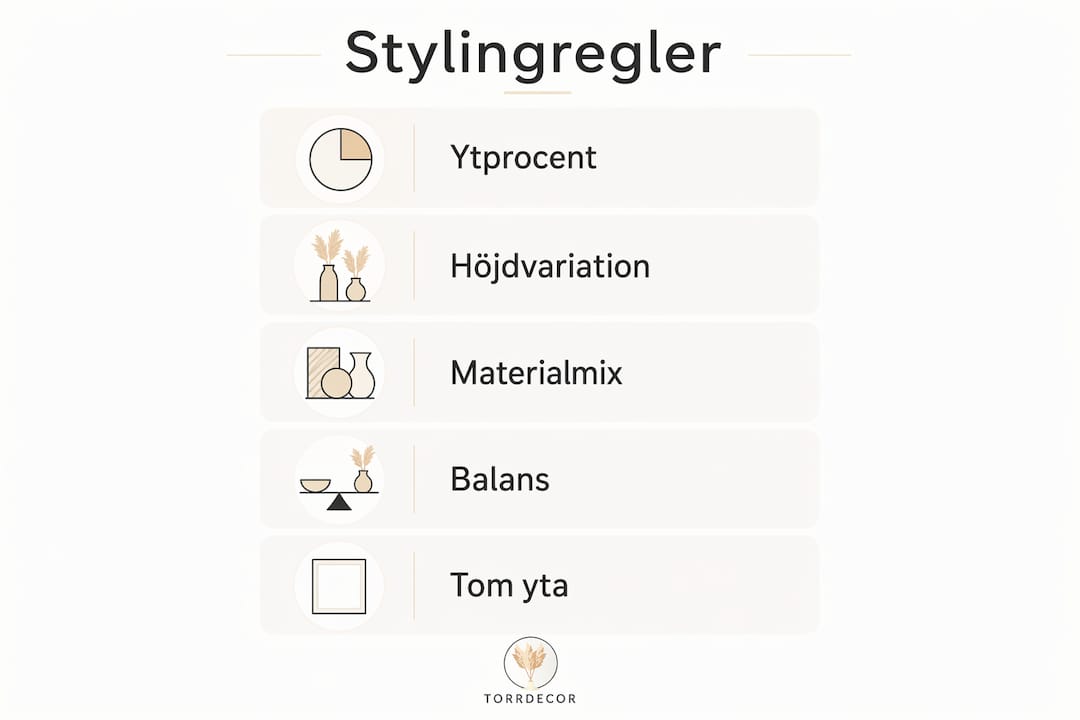
The third rule is the material rule. Three objects of different materials, shapes, and sizes create visual interest without disorder. A ceramic vase, a stack of books, and a natural material like pampas grass together form a complete composition.
The five components of a complete styling
A perfect coffee table styling balances five roles for a full visual impression:
- Anchor object: the heaviest and largest item, often a tray or a large book
- Vertical point: a tall element that draws the eye upwards, such as a slender vase
- Organic detail: a natural material like dried grass, a branch, or a flower
- Texture contrast: a soft or textured material against a hard one, such as linen against ceramic
- Negative space: intentionally empty areas that provide airiness and balance
| Component | Function | Example |
|---|---|---|
| Anchor object | Gathers the styling | Large tray, book stack |
| Vertical point | Creates height | Slender vase, 25–40 cm |
| Organic detail | Adds life and warmth | Pampas grass, dried bouquet |
| Texture contrast | Creates depth | Linen napkin, ceramic bowl |
| Negative space | Provides breathing room | Empty space along an edge |
How do you choose and arrange sustainable decorations?
The best anchor object for coffee table decoration is a large tray. Most people underestimate the size of their tray. A 45 cm tray often fits a standard coffee table better than a 30 cm one, as it brings together smaller objects into a unified composition. A small tray makes items look scattered, even if they are beautiful individually.
Books are an underestimated tool in coffee table decor. A stack of three to four books in a similar color palette functions both as a height provider and a personal detail. Choose books with neutral-toned spines like beige, white, or black if you want them to blend in. If you choose brightly colored books, let them be the only color accent in the room.
Vases and plants as organic elements
Decorative vases are one of the most important elements in coffee table styling. They work with or without flowers and add texture or color regardless. An empty vase of white clay or stoneware looks just as good as a filled one, making it a flexible choice for all seasons.
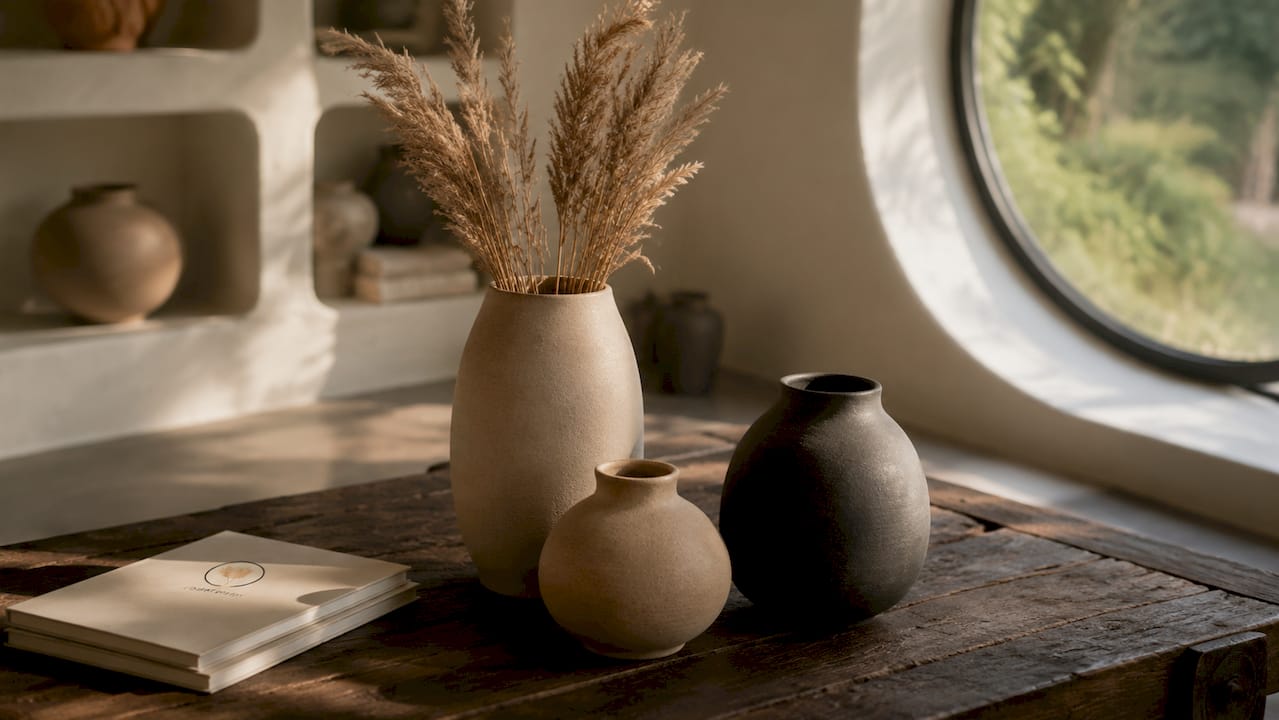
Dried plants are the most sustainable organic option. They require no care, do not shed leaves, and maintain their shape for months. Pampas grass is one of the most used materials right now and fits into both minimalist and Mediterranean-inspired environments. Combining a slender vase with a bunch of dried pampas grass gives you both height and organic texture in a single element.
Pro tip: Always choose an odd number of vases. One, three, or five vases look more natural than an even number, as the eye perceives odd-numbered groups as more dynamic.
Ceramics and natural materials are best combined on the same table. A bowl of raw clay next to a polished stone and a bunch of dried flowers creates the texture contrast that makes the styling interesting. You can read more about how to choose the right vase for different interior styles and functions.
The balance between function and aesthetics is crucial. Always leave room for a glass of water, a remote control, or a cup of coffee. A styling that cannot be used in everyday life won't last long.
How is styling adapted to the table's shape and placement?
The table's shape determines which styling method works best. This is a fact many overlook when copying a styling they've seen in a picture, without considering that the table in the picture has a different shape.
Rectangular tables
Rectangular tables are the most common and most flexible. Divide the surface into two separate styling zones along the length of the table. One zone gets a tall element and an anchor object, the other zone a lower arrangement with texture. Asymmetry between the zones creates more life than if you mirror them exactly.
Round tables
Round tables require central styling. Place the tallest element in the center and let the lower objects flow outwards towards the edges at varying heights. Avoid placing items in a perfect circle around the center. It looks stiff. Instead, let one object protrude slightly more in one direction.
Irregular and kidney-shaped tables
Irregular tables should be styled asymmetrically and slightly offset to highlight the table's shape as a sculpture. Place the heaviest element in the widest part of the table and leave the narrower part almost empty. The table's shape then becomes part of the styling itself.
- Identify the widest point of the table and place the anchor object there
- Add a vertical element near the anchor object, not in the center
- Place a low textured object at the narrower end
- Leave at least one edge completely clear
A tall vase or a decorative item should be clearly visible from the doorway. This provides the correct proportion and effect in the room as a whole. Remember that the coffee table is not only seen from above but also from a distance as you move through the room.
Walkways around the table affect how many items you can have. A table that is difficult to walk around should have fewer and lower objects. Practical accessibility is always more important than a complete styling.
| Table shape | Styling method | What to avoid |
|---|---|---|
| Rectangular | Two asymmetrical zones | Mirror symmetry |
| Round | Central styling with outflow | Perfect circular arrangement |
| Irregular | Asymmetry and off-center | Centered weight distribution |
Common mistakes in coffee table styling and how to avoid them
The most common mistake is having too many small items. Ten small objects always look messier than three medium-sized ones, even if the individual items are beautiful. The eye needs rest and cannot focus on ten things at once.
Over-decoration also blocks sightlines. If you're sitting on the sofa and can't see the person on the other side of the table, the styling is too high or too dense. The coffee table is a social surface and should not function as a wall.
- Too many items: remove half and see if it looks better. It almost always does.
- Wrong proportions: a small item on a large table disappears. Always choose objects that are proportionate to the table's size.
- No height variation: if all objects are the same height, the styling looks flat and dull.
- Ignored negative space: empty space is an active part of the design, not a failure.
- Styling without function: a table you can't use in everyday life creates frustration.
Pro tip: Photograph the table with your phone before you're satisfied. The camera sees proportions and imbalances that the eye misses when you're close.
The two-thirds rule means that objects cover approximately two-thirds of the table's surface and that at least one edge is left free. It's a simple benchmark to return to when you feel something isn't right. The rule works for most table sizes and styles.
Editing is a skill in itself. Remove one object at a time and evaluate the result after each removal. Personal touch doesn't have to mean many items. A single vase with a bunch of dried pampas grass can say more about your style than ten scattered trinkets. You can get inspiration for sustainable decorative vases that act as anchor points on the coffee table.
Seasonal adaptation is a way to keep styling fresh without buying new. Change a single element per season. Winter coffee table ideas might involve adding a small pine cone or a candle. In summer, simply swapping the vase for a lighter model or adding a bunch of dried flowers in warm tones is enough.
My experiences with coffee table styling
It took me a long time to understand that the best thing I can do for a coffee table is to remove items, not add more. Every time I've felt something wasn't right, the solution has almost always been to remove an object rather than look for a new one.
Texture is the element that creates the most warmth and is most often overlooked. A smooth marble tray next to a rough linen fabric and a bunch of dried grass creates a feeling that no amount of glossy items can replace. The materials speak to each other, and it's that conversation that makes a styling memorable.
Sustainability choices affect the long-term value of the styling. Dried plants and ceramics last for years, not weeks. It's a choice that saves both money and time. If you choose long-lasting materials, you don't need to replace the styling every month to keep it looking fresh.
To those who are beginners: start with an anchor object, a vertical element, and an organic material. That's enough. To experienced stylists: challenge yourself to remove an item you thought was necessary. The result is almost always surprising.
— a4
Torrdecor's products for sustainable coffee table styling
Torrdecor offers a range of dried plants and handmade vases that fit directly into the styling principles described here.
Pampas grass 110 cm is one of the most used elements to create height and organic texture on a coffee table. It requires no maintenance and holds its shape for months. If you want a more dramatic expression, Pampas grass ‘VILDA’, with its fuller and wilder character, is suitable. Vases from Torrdecor are made in Portugal from white clay and work equally well empty or filled. They fit into everything from minimalist to Mediterranean-inspired homes and are a natural choice for those who want to build a sustainable and aesthetic coffee table styling.
Frequently asked questions
How much of the coffee table should be covered by decorations?
The anchor object should cover 33–50% of the surface, and at least 40% should remain empty. The empty space is an active part of the styling.
How many items should a coffee table have?
Three objects of different heights, materials, and forms are the basic rule. This creates visual interest without the surface feeling cluttered.
What materials are best suited for a coffee table?
Ceramics, natural materials like dried grass, and wood are good to combine. They create texture contrast and last a long time without maintenance.
How do I adapt the styling to the season?
Change a single element per season, such as a vase or a natural material. This is enough to keep the styling current without having to start from scratch.
Do dried plants work on a coffee table?
Dried plants are one of the best choices for coffee table styling. They require no care, maintain their shape for months, and provide organic texture that living plants cannot always offer on a small table.
Key insights
A well-styled coffee table surface requires an anchor object covering 33–50% of the surface, clear height variation at three levels, and at least 40% empty space to create balance and function.
| Point | Details |
|---|---|
| Anchor object and surface | The anchor covers 33–50% of the table; at least 40% is left empty for air and function. |
| Height variation at three levels | Use a tall object (25–40 cm), a medium-height object (12–20 cm), and a low object (3–10 cm). |
| Material rule | Combine three objects of different materials, shapes, and sizes for visual interest without disorder. |
| Table shape determines the method | Rectangular tables are styled in zones, round ones centrally, and irregular ones asymmetrically. |
| Edit, don't add | Remove one object at a time until the balance feels right. Fewer items often give better results. |
0 comments